Archive for the ‘Going Deeper – Hebrew and Greek Word Study Posts’ Category

God’s Parties:  The Feasts of the Lord

By Amy Hartmann

How Passover is a shadow of Easter glory!

I’ve given many parties in the past.  Most were well received by the invited friends and family members I called to my house.  On a couple of occasions, situations prevailed that kept the invited away and all my preparations went unnoticed or appreciated.  Some of the food even had to be thrown away.  What happens when God throws a party and nobody deems it important enough to attend?  Jesus shared such a story in His parable of the marriage feast.  “The kingdom of heaven is like a king who prepared a wedding banquet for his son.  He sent his servants to those who had been invited to the banquet to tell them to come, but they refused to come.”[1]

Years ago, during our season of life in Jacksonville, Florida our Pastor, Bishop P.D. Zink began presenting the significance of the Feasts of God outlined in the 23rd chapter of Leviticus.  I experienced some emotional resistance to this concept.  I read the letters the Apostle Paul wrote to the Roman churches and the church at Colossae.  I understood Paul’s position on the legalism which blinded and bound up the Pharisees and Sadducees.  I grasped the significance of religious ritualism not making me right with God.  I comprehended the emptiness of sacrifice without repentance.  I also got the pictures Ezekiel and Malachi painted when they outlined the Aaronic priesthood’s failings to properly respect being allowed to approach God in the first place, all be it under the old covenant rules spelled out so laboriously in the laws of Moses.

I began to ponder the grafting in of Gentile believers into God’s original Jewish church.  The Apostle Paul called this ‘one new man’ in his letter to the Ephesian believers.  I had read through Romans Chapter 11 many times and not really understood the ‘grafting’ concept until I began researching plant propagation for a book I was working on at that time.  I read Paul’s words telling me that we Gentiles were ‘wild olive shoots’ and that we were being grafted into the main, cultivated olive tree.  I had a lot of questions:  what was the significant difference between a wild olive tree versus a cultivated one?  Was the fruit better?  Did the host tree receive any benefits from the grafted stem?  One thing was clear from Paul’s example:  the root supports the graft.

Perhaps these were just figures of speech written to help us get a visual understanding.  I am a visual learner and such examples and parables open my mind to spiritual concepts.  Yet, a passage in Zachariah Chapter 14 haunted me for such a long time…”…in that day living water will flow out from Jerusalem…the survivors from all the nations that have attacked Jerusalem will go up year after year to worship the King, the Lord Almighty AND to celebrate the Feast of Tabernacles.  If any of the peoples of the earth do not go up to Jerusalem to worship the King, the Lord Almighty, they will have no rain.[2]

Living in North Florida for so many years, I learned a very important lesson:  no rain means no water…no water means great fire!  Fire weather is a fearsome condition to live with on a regular basis.  No rain means drought.  No rain means no crops.  No rain means dead grass and brush everywhere.  No rain means suffocating heat.  No rain means dangerous breathing conditions.  Just the air quality problems are enough to make everyone in the community sit up and take notice.  Enough smoke in the air will make everyone sick.  When the winds begin to carry the fire, nothing can stop it but rain or the complete exhaustion of fuel.

“These are My Feasts,” God said to Moses.  “I just want to be with you!”

Maybe I am over simplifying Leviticus Chapter 23 but these sacred assemblies were set times to celebrate the NOW presence of God drawing near to love on His people.   He wanted to spend face to face time with all of those willing to draw near.  This is an amazing concept to grasp.

The Apostle Paul gives this directive in his writing to the Corinthian church: keep the feasts, not with the old leaven of the law, but with the new understanding that Jesus has fulfilled all of these ‘unfollowable’ commandments.  “For Christ, our Passover Lamb, has been sacrificed.  Therefore, let us keep the Festival, not with the old yeast of malice and wickedness, but with the bread without yeast, the bread of sincerity and truth.”[3]

We don’t have to keep the feasts…we get to!  He lets all of us who were never acceptable because of our birth, our gender or the color of our skin NOW celebrate with Him without fear of censure!  The gospel writer Luke understood this when he recorded the response of Zechariah the priest’s words, “…to enable us to serve Him without fear in holiness and righteousness before Him all our days.”[4]  I think about this concept a lot.

Prior to Jesus’ death on the cross, only the ceremonial clean Jews were allowed to approach God.  All Gentiles – everyone not born a Jew – were NEVER allowed in the Temple in Jerusalem.  Paul faced an angry Jewish mob because they thought he brought Trophimus, a Greek, into the Temple area (Acts 21:29).  The Jews from the province of Asia determined he had desecrated the Temple in this way and a riot broke out (Acts 21:26-32).

In those days, I would not be ‘good enough’ to ever come before God.  In those days, I would have been stopped by the temple police for trying to come into the Temple and approach the God of Abraham, Isaac and Jacob.  Such an attempt would have brought about my death either from the acceptable worshipers or my own uncleanness in coming before the Holiness of God.
DSCN9056

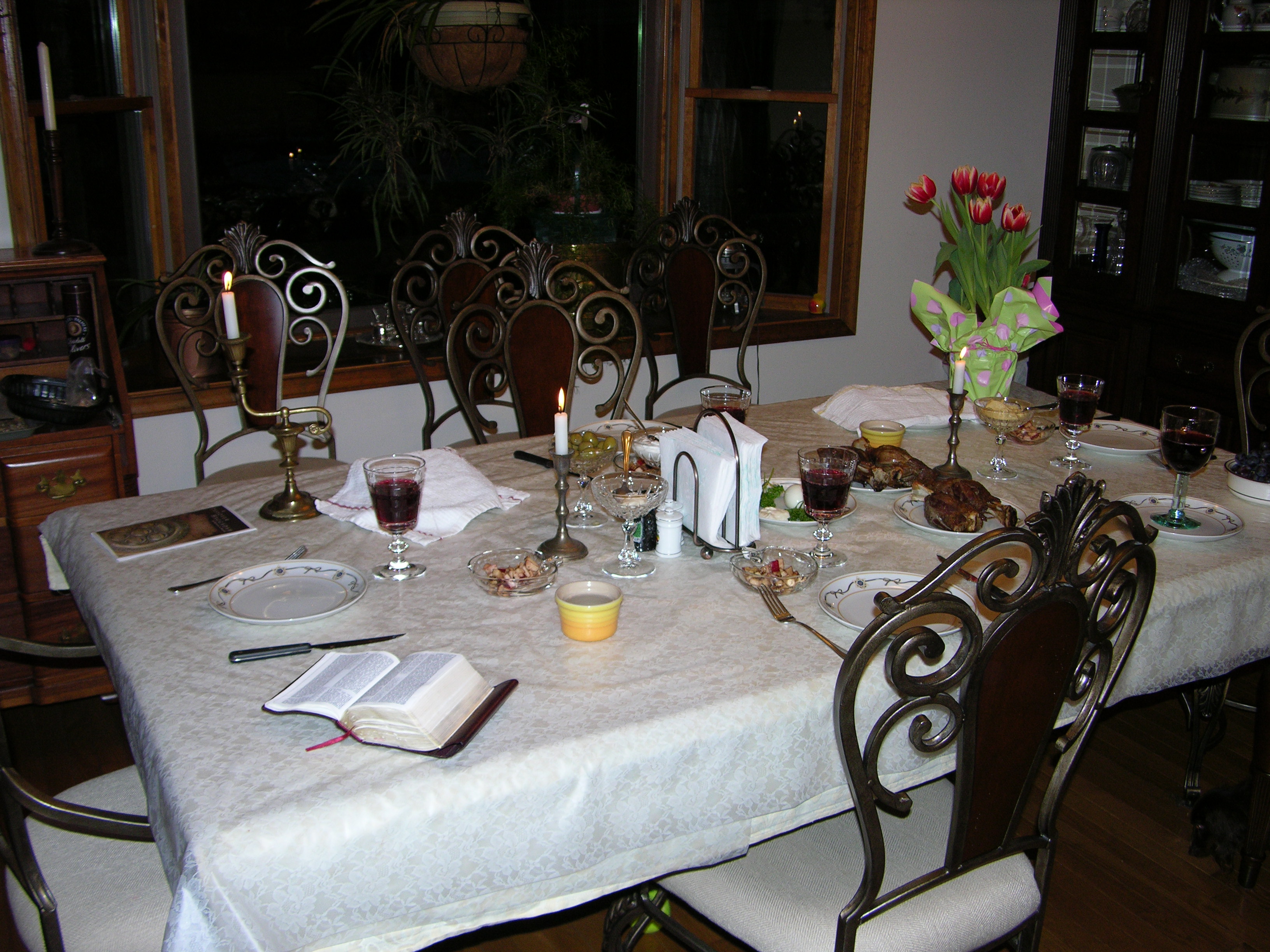
My family sat down Monday evening, when Passover began at sundown, and we took communion after we read the original Passover passage in Exodus 12.  In Matthew Chapter 26, we see Jesus sitting down with His disciples to celebrate this same feast.  During this most important ‘Last Supper’ celebration, Jesus took some of these same Seder items and began to correlate them to Himself and the work God had given Him to accomplish.  Luke records these words, “Do this in remembrance of Me.”[5]

We began to feast on some roasted lamb and the bitter herbs and other things on the Seder menu.  My meal was by no means kosher but most of those rules are man-made and not in the original passage in Exodus 12.  I didn’t throw out all of my bread, crackers or food items that contained leaven.  Most of the processed foods today, such as pasta, cereal, chips etc. may contain some sort of leavening agent and I would have to be a chemist to understand this all fully.  I would also have to dump a huge portion of our food items.  The sheer financial impact of that act would be impossible for me to shoulder right now.  Taking them out of the house and asking someone to keep them for me till the feast period is over seems to be cheating the original text, in my opinion.

The old leaven God was bringing into focus to the people of that day was a way to present a visual image of sin – not just the existence of yeast.  My prayer over our meal was for Holy Spirit to rid me of the real leaven…the unforgiveness, the complaints, the slander, the fear, the bitterness and anger that strife and conflict often breeds.  These are the real issues that can separate me from God and from others.  It is so important to remember who Jesus is and where Jesus was born.

Here are my notes and the word studies that helped me:

1.  The first Passover in Exodus 12 is a shadow of what Jesus would do when He died on the cross.  Remember Revelation 13:8…Jesus was slain from the foundation of the world.  Jesus was also loved from the foundation of the world as we see in  John 17:24.  He knew He was going to die before He ever began His public ministry…”The reason My Father loves Me is that I lay down My life – only to take it up again.  NO one takes it from Me, but I lay it down on My own accord.[6]

2.  It was the High Priest’s duty to kill and sacrifice the sin offering – this is very important to understand (Leviticus 9:1-11).

3.  What the first Passover provided:  Psalm 105:37-45

a. Escape from the death angel – Exodus 12:12-30; a call for a lasting ordinance between God and His people

b. Freedom from slavery and bondage – Exodus 12:40-42; Exodus 13:14-16

c. Everyone was strengthened, even the elderly; no one was sick or infirm; Psalm 105:37

d. He was a light and a covering from the weather/heat

e. Their clothes did not wear out

f.  He provided food and water everywhere they went

g. They received a new inheritance…a future and a hope.

h. They spoiled the Egyptians and they came out wealthy…payback for the 430 years of slavery and stolen wages.

4.  In John 2:13, Jesus is in Jerusalem for the Passover and to become the fulfillment of the Passover.  He is mad because He sees the people being cheated; the lambs they bring are acceptable to God.  However, the Temple priests won’t accept the lambs from the people but demand that the people buy ‘approved’ lambs from the Temple flocks.  The money changers and animal sellers make money off the trades/exchanges (John 10:7).

5.  Jesus declares, “I AM the door of the sheep; in Jerusalem, the sheep gate was the entrance in the northeastern corner of Jerusalem’s city wall (see Neh. 3:1, 12).  Apparently, sheep for the Temple sacrifice entered the city through it.  It was close to the Pool of BethesdaRead John 5:1-9 to see a picture of what Jesus came to accomplish in us.

6.  Bethlehem means ‘House of Bread’.  The Bread of Life was born in the house of bread.  Bethlehem – Strong’s No. 1035 (Hebrew) from bayith (1004) means ‘house’; and 3899 ‘lechem means ‘bread’.  See (Exodus 25:30).

Bethlehem was also the holding ground for all the sheep being brought into Jerusalem and sold at the Temple for sacrifice during the Feasts of the Lord (Deuteronomy 16:1-17).  Approved and acceptable Temple sacrificial lambs were raised by shepherds on the hills of Bethlehem.

7.  John 1:29 John the Baptist declared Jesus, “the Lamb that takes away the sin of the world.”  He did this since the priesthood had not done so as they should.

8.   God says, “These are MY appointed feasts.”Leviticus 23:1-44 (note: vs. 14, 21):

a.  The Sabbath – 6 days you may work, but the 7th day is a Sabbath of rest; a day of sacred assembly.  Our Saturday is the Sabbath.  Sunday is the first day of the week.

b.  The Passover – on the 14th day of the first month; it begins at twilight.

c.  The Feast of Unleavened Bread – on the 15th day of the first month – 7 days no bread made with yeast.

d.  First Fruits – bring the first from your harvest to the priests on the day after the Sabbath (our Sunday)- the 3rd day after Passover.

eFeast of Weeks – Pentecost – count off 50 days from the 7th Sabbath of the first month (7 full weeks from Passover).  Pente means ‘50’ and it celebrates God giving the Ten Commandments to Moses on the mountain.

f.  The Feast of Trumpets – the first day of the 7th month.

g.  The Day of Atonement – from sundown on the 9th day until sundown on the 10th  day of the 7th month – a solemn time of fasting, personal examination of sin;  it is the most holy day of the year.  It is also a Sabbath rest day.

h.  The Feast of Tabernacles – the 15th day of the 7th month – this feast lasts for 7 days.  No work is to be done during this week; on the 8th present an offering to the Lord at the sacred assembly.  Live in booths (Let’s go camping – oh yeah!).

9.  Jesus is The Fulfillment of The Lord’s Feasts:

aIn death, Jesus rested on the Sabbath.  He was buried before sundown on Good Friday (His crucifixion day).  Jesus arose from the grave on the first day of the week (our Sunday).    Matt. 28:1-10; Mark 16:9-20 (note Acts 28:3-6);  Luke 24:1-8; 44-49; John 20:1.

b.  Jesus celebrates His last Passover, introduces Communion and becomes the Passover Lamb for the sin of the world;  Luke 22:1-13; John 13:1, John 18:28-40; John 19:10-12; John 19:31-37; He is buried before sundown, as the Passover feast begins for the nation of Israel -John 19:42.  See I Corinthians 5:6-8,  Revelation 13:8b

c.  Jesus, the sinless Bread of Heaven introduces His body as the Unleavened Bread sacrifice.  John 6:48-63 and Matthew 26:28.  Leviticus 2:4-11; Mark 8:15, I Cor. 5-7-8; Galatians 5:9.

d.  Jesus, first born among the dead, Romans 8:23, I. Corinthians 15:20-23;I Cor. 15:20-26, James 1:18; Romans 11:11-29.  Key on verse 29!  

e.  Jesus breathes on the 11 remaining disciples and tells them ‘receive the Holy Spirit’. (John 20:19-20; Luke 24:45-49 – “tarry in the city until you have been clothed with power from on high”.  Acts 2:-5; Acts 2:1-4; The Holy Spirit comes with power on the 120 waiting per Jesus’ final instructions in Luke and John.  This event happens on the Feast of Pentecost, 50 days after Jesus was crucified.

f.  The Feast of Trumpets – the blowing of trumpets – all day.  I. Thessalonians 4:14-18 (the rapture of the church –  unfulfilled); Zechariah 9:14; Zechariah 14:1-9; Matthew 24:30-31

g.  Atonement – Rosh Hashanah; Final judgment, the Book of Life opened – unfulfilled (Rev. 20:11-15).

h.  The Feast of Tabernacles – God makes His dwelling with us (Rev 21)– unfulfilled – Jesus kept this feast; He declared Himself to be the Living Waters that would be in us, streams of living water; John 7:1-41;Zechariah 14:16-20.  Parable of the Great Banquet:  Luke 14:15- 23.

i.  Jesus – Strong’s Hebrew 3091[from 3068 Yehovah – the self-Existent or Eternal; Jehovah, Jewish national name of God, Jehovah, the Lord; and 3467 yasha (yaw-shah) to be open – wide or free; to be safe, cause to free or succor; avenging, defend, deliver or deliverer, help, preserve, rescue, be safe, bring salvation, save or savior, get victory.  Jesus – Strong’s Greek 2424.


[1] Matthew 22:1-14.; “The Comparative Study Bible – New International Version ,” copyright 1999; Zondervan; Grand Rapids, Michigan; pages 2491 and 2493.

[2] Zechariah 14:1-21, ibid; pages 2411 and 2413.

[3] I Corinthians 5:7-8; ibid, page 2917.

[4] Luke 1:67-79; ibid, pages 2589 and 2591.

[5] Luke 22:7-20; note verse 19; ibid, pages 2673 and 2675.

[6] John 10:14-18; ibid, page 2727.

By Amy Hartmann

August 20, 2012


For many years now, I have been eager to understand the true meaning of the word worship.  Churches have their designated worship programs and worship leaders.  Television has its idol reviews.  Football team mania, movie star adulation, body builder obsession and people addicted to tanning are all examples of this word in action around us.  Worship, as a word, has been strewn about in the public arena to mean many different things.

In my grandparents days, worship was a more simpler ideology and it generally referred to man’s direct response to God as Creator and Sustainer of all living things.  Awesome was a biblical word and it pointed out a unique characteristic or action that belonged to God alone.

Now days awesome and worship refer to everything from shoes to the latest reality TV persona.  Something deep inside has called me to bypass all of this superficial marketing excess and examine the origin of worship.  Looking past the seen examples in everyday life, I began studying the biblical words for praise.  Ray Hughes and numerous other worship leaders have laid foundational principals in my understanding.  However, Don Potter’s book, “Facing the Wall”[1] brought me up to the next level.  He wrote this book specifically for “praise leaders and those who love to worship”.[2]

Don Potter’s writings opened my understanding of praise to be so much more than mere sound and emotion.  Don taught me that praise was a elemental tool for opening up the human heart to the manifest presence of God.  He also introduced a key aspect of the responsibility of praise and worship leaders: teaching the people to differentiate between the holy and the profane – causing them to discern between the unclean and the clean (Ezekiel 44:23).[3]

Don’s work also revealed some of the significant Hebrew words for praise and their unique and often extreme differences.  I looked up all the words for praise in Strong’s Concordance.[4]  Raising our hands in praise as a way of saying thanks to God, or in supplication for deliverance from our problems are directions found in the words yadah (Strong’s Old Testament Reference 3034) and towdah (Strong’s OT 8426).  Kneeling in praise and prayer comes from the word barak (Strongs’s OT 1288).  The word zamar (Strong’s OT 2167) shows praise through music and the plucking of strings.  Tphillah praise (Strong’s OT 8605) is prayer sung as a hymn.  Taqa praise (Strong’s OT 8628) comes through loud trumpet blasts or the clapping of hands.  Shabach praise (Strong’s OT 7623) is rather noisy too; it involves shouting with a loud voice, cheering and celebrating with great joy.

Perhaps the most important word for praise is tehillah (Strong’s OT 8416).  This form of praise involves spontaneous, new songs offered in the moment of live worship.  Psalm 22:3 says that the manifest presence of God is enthroned in our midst when we praise Him this way.

I think that it is more than just a coincidence that one of the main words, barak, which instructs us to kneel before God and praise Him, happens to be the name of the current president of our nation.  I believe this is a prophetic clue from God showing us what it will take to heal our land.  Proverbs 25:2 tells us that “It is the glory of God to conceal a matter; to search out a matter is the glory of kings.”  I still felt there was more to understand about worship.

It occurred to me that I should look up worship too, and I was quite surprised by the results.  There are four main words for worship in the Old Testament writings, the most important and frequently used word being shachah (Strong’s  OT 7812).  It is used about 100 times in the Old Testament and it represents the primary response by the majority of the OT patriarchs.  It means to bow down, crouch, fall down, be flat, humbly beseech, make obeisance, do reverence, to make to stoop down, to worship. We see this expression of worship begin with Abraham.  Moses worshiped this way when he was with God on Mount Sinai.[5]

The New Testament equivalent of this word is the Greek word proskuneo (Strong’s NT 4352).  Jesus bowed to God in worship in this way throughout the four gospels of Matthew, Mark, Luke and John.  The word is used about 60 times throughout the New Testament.

Proskuneo is the form of worship the devil wanted Jesus to offer to him in exchange for all the worldly kingdom authority and dominion which the devil had taken from Adam in the Garden of Eden.  This was a valid offer of trade, and the foundational understanding of why there is evil in the world today.

We see accounts of people being groomed and prepared to meet with the Queen of England; and it is unheard of NOT to obey the royal protocol spelled out prior to such a privilege.  These references revealed my need for a deeper level of respect in my response to God, especially in personal prayer times.  I have reconsidered the awesome privilege of entering God’s presence, and respecting Him all the more in my obedience to His word.

Finally, this research delivered up a much misunderstood principal of worship which I was lacking.  The Old Testament word atsab (Strong’s 6087) found in Jeremiah 44, verse 19 reveals a fearful form of worship being offered to placate an angry and judgmental deity known as the queen of heaven.  Worry and fretting about not appeasing her correctly was the point of the text.

In Acts 7:42 we see God giving over unrepentant mankind (who refused to recognize Him as Sovereign, holy and worthy of complete devotion) to this form of self degradation.  The correlating Greek word used here is latreuo, with its root coming from the concept of being a hired menial laborer or a lowly slave.

In the Sermon on the Mount, Jesus gave this imperative command in His most recognized appeal to the mass of humanity at His feet, “Therefore I tell you, do not worry about your life, what you will eat or drink; or about your body, what you will wear…who of you by worrying can add a single hour to his life?”[6]  It was also the heart behind His response when one of the teachers of the law questioned His opinion of the greatest commandment.

“The most important one,” answered Jesus, “is this: ‘Hear, O Israel, the Lord our God, the Lord is One.  Love the Lord your God with all your heart and with all your soul and with all your mind and with all your strength’.  The second is this: ‘Love your neighbor as yourself.’  There is no commandment greater than these.”[7]

God does not want us to worry and be afraid.  He does not want us to worship our problems and exalt them over His love and care for our lives.  Over the past few years, God has been planting this understanding deep in my heart through the life events that we have faced in the turbulent economic times which have shaken our finances repeatedly.  Over and over again I hear His quiet, still voice…”Amy, do you trust Me?”

“Yes, Lord,” my heart cries out even through my tears, “I trust You and I refuse to lean on my own understanding of each trying issue on my path.  In all my ways I am going to acknowledge You and seek Your direction because You are my Shepherd.  I will bow down and I will worship.


[1] Potter, Don, “Facing The Wall,” copyright 2002, Potterhaus Music; Moravian Falls, NC.

[2] Potter, Don, ibid, cover page and page 1.

[3] Potter, Don, ibid; page 40.

[4] Strong, James; LL.D., S.T.D; “The New Strong’s Exhaustive Concordance of the Bible,” copyright 1995, 1996; Thomas Nelson Publishers, Nashville, TN.

[5] Exodus 34, “The Comparative Study Bible,” copyright 1999; Zondervan; Grand Rapids, MI; pages 235, 237 and 239.

[6] Matthew 6:25-34; ibid, page 2441.

[7] Mark 12:28-34, ibid, page 2567.

By Amy Lee Hartmann

August 20, 2012

     Being the heroine in any event is always thrilling.  Being heralded as the leading lady who brought about great victory – or salvation – or deliverance causes many a woman to aspire to achieve great things when under personal, social, moral or political pressure.  Rising to the rank of queen, or brave woman, or leader is cause for great celebration. However, the shoes of the defeated, swept away, rightly disposed individual often hold just as a compelling human being whose failures leave key life lessons too!  Such is the story of the renowned beauty, Queen Vashti, royal hostess and much admired companion of  King Xerxes.

“Xerxes (also known as Ahasuerus) was a Persian king who reigned 486-464 B.C. …He was the son of Darius The Great and grandson of Cyrus the Great.[1]  Persia was a vast collection of states and kingdoms reaching from the shores of Asia Minor in the west to to the Indus River valley in the east.  It reached northward to southern Russia, and in the south included Egypt and the regions bordering the Persian Gulf and the Gulf of Oman”.[2]

This territory encompasses modern day Iran.  The book of Esther describes this kingdom as reaching from India to Ethiopia – over 127 provinces all together.  By today’s reckonings, that would include many well recognized nations.  Vashti had the world and this powerful man at her feet.  All the wealth and resources of one of the largest and most well organized kingdoms in biblical history were at her disposal.  Her very name meant “the once desired, the beloved.”[3]

King Xerxes had been on his throne for three years when he decided to hold a feast for all his princes and servants.  Biblical accounts suggest that these sort of celebrations were not that unusual.  King Solomon and King Hezekiah are leaders who utilized these events to proclaim their status to their world.  The court of King Xerxes feasted for 180 days.  During this time he showed off his “glorious kingdom and the splendor and excellence of his majesty.”[4]  At the end of this elaborate extravaganza, the king then made a feast for all the inhabitants of the royal city, from the least to the greatest alike.  This banquet carried on for seven more days.

Vashti’s story unfolds in this majestic setting of the citadel of Susa, the winter capital of the ancient Persian Empire.  The palace gardens were decked with elaborate, sumptuously colored linen hangings fastened with white linen cords laced through silver grommets.  These draperies were supported by marble columns seated on a mosaic pavement of mother-of pearl, marble, costly stones and porphyry (red marble stones composed of feldspar crystals embedded in a dark red or purple ground mass)[5].  Couches of gold and silver provided the perfect seating for this imperial garden party.

Royal wine was abundant and liberally served by the wine stewards.  The people were encouraged to drink according to their own desire.  Queen Vashti made a feast for all the women of the palace household at this same time.  Susa was rocking!

On the seventh day of the final feast, the heart of the king was gladdened by much revelry and wine, so he decided to show his subjects one of his greatest treasures, his beautiful Queen Vashti.  The texts say that she was very fair and lovely to look upon.  It was at this very moment that divine destiny crept in and raised one of those unique portals that caused time and chance to shift.  Maybe Queen Vashti was tired; after all she had played hostess to a large banquet of high maintenance women from the palace.  Maybe she just didn’t feel good and hadn’t been wise about all of her banquet choices.  Regardless of her reasons, at this critical juncture of her life, she chose to disregard the royal eunuchs sent to prepare her to appear before the king.  She refused to wear her crown.

Her husband was enraged.  The princes and royal advisers trembled with anger and fear.  The wise-men were called, “those who understood the times, the law and judgment.”[6] Memucan, one of the king’s closest advisers gave this reply:

“Vashti the queen has not only done wrong to the king but also to all the princes and to all the peoples who are in all the provinces of King Ahasuerus.  For this deed of the queen will become known to all women, making their husbands contemptible in their eyes, since they will say ‘King Ahasuerus commanded Queen Vashti to be brought before him but she did not come’.  This very day the ladies of Persia and Media who have heard of the queen’s behavior will be telling it to all the king’s princes.  So contempt and wrath in plenty will arise.”[7]

Another translation says, “This very day the Persian and Median women of the nobility who have heard about the queen’s conduct will respond to all the king’s nobles in the same way.  There will be no end of disrespect and discord.”[8]

Contempt, wrath-in-plenty, unending disrespect and discord….such are the fruits of dishonor.  How many of us have stood in similar shoes…maybe not as politically heeled as Vashti’s…but still shoes that carry the same weight in our world and our circumstances?  Another renowned wise king named Solomon gives us this perspective, “The wise woman builds her house, but with her own hands the foolish woman tears hers down”.[9]

The Apostle Paul, gives this insight into the topic of honor and respect in marriage when he writes to the Ephesian church:

“Wives, be subject to your own husbands, as to the Lord.  For the husband is the head of the wife, as Christ also is the head of the church; He himself being the Savior of the body…Husbands, love your wives, just as Christ also loved the Church and gave Himself up for her…nevertheless, each individual among you also is to love his own wife even as he loves himself, and the wife must respect her husband.”[10]

Paul repeats this same directive to the church at Colossae:

“Wives, be subject to your husbands, as is fitting in the Lord.  Husbands, love your wives and do not be embittered against them.

These admonitions aren’t popular and politically correct attitudes now days, but that does not mean that they aren’t the foundational answer to many relationship problems between a husband and wife.  Why would God repeatedly command a husband ‘to love his wife as he loves himself ’unless there was going to be this disconnect in the attitudes of a husband.  God was warning  that this is a key issue in keeping the heart of a wife free from hurt and bitterness.

Why would God reiterate again and again ‘that the woman must respect her husband’ unless this was going to be a key issue in keeping the husband’s heart free from hurt, anger and bitterness?

Being subject does not mean being abused.  The Greek word is hupotasso and it really means to obey, to respect and to come up under and look up to.

At this solemn moment in Vashti’s life, her fate is sealed.  There is no second chance.  “Therefore, if it pleases the king, let him issue a royal decree and let it be written in the laws of Persia and Media, which cannot be repealed, that Vashti is never again to enter the presence of King Xerxes.  Also let the king give her royal position to someone else who is better than she.  Then, when the king’s edict is proclaimed throughout all his vast realm, the women will respect their husbands, from the least to the greatest.”[11]

The rest of the story goes like this:  “After these things, when the wrath of King Xerxes had subsided, he remembered Vashti and what she had done and what he had decreed about her.”[12]  The King’s personal servants suggest the king issue a call for all the fair young virgins of the provinces to be brought into the palace of Shushan.  This royal search will find a suitable new queen.  A multi-year long beauty pageant brings a host of young women and an orphaned Jewish girl named Hadassah into the palace for purification and beauty treatments.

Hadassah’s uncle Mordecai insists she use the Persian name of Esther to mask her nationality and family background.  The text says she continued to obey and follow her uncle’s directions the entire time she was in the palace, just as she had done when he was bringing her up.  One interesting aspect of Esther’s story is found tucked away in the technical details of this book:  Queen Vashti disobeyed the king’s command at the end of the banquet in the third year of Xerxes’ reign.  Esther’s turn to be with King Xerxes took place in the tenth month of the seventh year of his reign.  Four long years of complete obedience to the eunuchs in charge had to pass before Esther’s divine portal opened and her destiny came forth.

Esther’s time as Queen ultimately provides the opportunity for her to stand up for her people.  Hatred for the Jewish people rises up in Haman, one of the king’s closest advisers, and he plots ethnic cleansing of the entire kingdom of Persia. When Mordecai learns of this edict, he tears his clothes, dons sackcloth and ashes, and then goes out into the city, lamenting loudly for his people.  Esther’s maids and royal servants carry this distressing information to the young queen and she sends one of the king’s eunuchs to investigate.  Through the eunuch, Mordecai urges Esther to go before the king and plead for mercy.

Esther fearfully reminds her uncle that the laws of the royal province state that anyone who approaches the king in his inner court without being summoned directly by the king, receives an immediate death sentence, unless the king extends his royal scepter to that person.  She nervously confides that it has been thirty days since she was last called into the king’s chambers.

Uncle Mordecai gives this compelling direction to Esther, when the royal edict is released to all the other provinces of the kingdom:

“Do not think that because you are in the king’s house you alone of all the Jews will escape.  For if you remain silent at this time, relief and deliverance for the Jews will arise from another place, but you and your father’s family will perish.  And who knows but that you have come to royal position for such a time as this?”[13]

“Go, gather together all the Jews who are found in Susa and fast for me; do not eat or drink for three days – night or day – and I and my maidens also will fast in the same way.  And thus I will go into the king, which is not according to the law; and if I perish, I perish,” Esther replies.

On the third day, Esther put on her royal robes and stood in the inner court of the palace in view of the king.  When King Xerxes saw her he was pleased and he held out to her his golden scepter.  Over the next few days, Esther humbly serves the king and the enemy adviser through a series of banquets.  The king is captivated and demands she make her petition before him, even up to half of his kingdom!

Finally, in a moment of high drama, she pleads for her life, and that of her people.  Haman’s evil plot of ethnic cleansing is exposed!  The King’s rage at the intrigue of this plot boils up and he races out of the banqueting hall to call for his advisers.  In a panic, Haman falls upon the young queen, begging for his life.  The king returns just as Haman grabs for Esther and that triggers the portal for Haman’s demise.

“Will Haman even molest the queen while she is with me in the house?” Xerxes angrily exclaims, as the guards cover Haman’s head and drag him away.  The very instrument of death Haman has erected for the killing of his Jewish enemies becomes his own execution site; and sadly, the same for his ten sons.  The king grants Mordecai the task of issuing a new edict that grants the Jews in every province the right to defend themselves from the previous order calling for their death.  Thus the Jewish holiday of Purim is created as a remembrance of the deliverance of Queen Esther and her people.

Regrettably, “…no (other) records yet have been recovered which name Vashti as the queen of any king of the Medo-Persian Empire…”[14]  Vashti was swept away without further mention. Vashti’s parting epitath might well be, “The test of honor came when least expected but its consequences endured for a lifetime.”


[1] Xerxes, “The Holman Bible Dictionary;” Trent C. Butler, PH.D., General Editor; copyright 1991; Holman Bible Publishers, Nashville, TN; page 1428[2] Persia, ibid, page 1097.

[3] Vashti, ibid, page 1388.

[4] Esther 1:4, “The Comparative Study Bible,” copyright 1999; Zondervan, Grand Rapids, MI; page 1260.

[5] Porphyry, “The Holman Bible Dictionary;” Trent C. Butler, PH.D., General Editor; copyright 1991; Holman Bible Publishers, Nashville, TN; page 1125.

[6] Esther 1:13, “The Comparative Study Bible,” ibid, page 1260.

[7] Esther 1:16-18, “The Comparative Study Bible – The Amplified Version,” ibid, page 1260 and 1262.

[8] Esther 1:18, “The Comparative Study Bible – New International Version,” ibid, page 1263.

[9] Proverbs 14:1; ibid, page 1621.

[10] Ephesians 6:22, 23, 25,33; Colossians 3:18,19;ibid, pages 3011 and 3035 .

[11] Esther 1:19-20; ibid, page 1263.

[12] Esther 2:1-4; ibid, page 1263.

[13] Esther 4:12-14; ibid, page 1269.

[14] Vashti, The Holman Bible Dictionary;” Trent C. Butler, PH.D., General Editor; copyright 1991; Holman Bible Publishers, Nashville, TN; page 1389.