Archive for the ‘The Feasts – God’s Parties’ Category

By Amy Hartmann

July 15, 2013

The month was September – early fall –  but in northeast Florida, that meant it was still very hot outside.  The year was 2009 and the day was Friday, the 18th.  Rosh Hashanah was beginning at sundown and I was hurrying to get many tasks done for the afternoon.  One key task was to make fresh challah bread for the 24 hour prayer gathering commencing at our church that evening.  The idea of making fresh bread had been on my mind for several weeks and I pondered the timing amid all of my responsibilities.  My kids had doctor’s appointments that week; my daughter had art class and everyone was busy with school and work.  I had already planned to join the service around midnight but I knew the bread needed to be there before the service began.

The average bread cycle time is almost 4 hours from start to finish.  Finding such a block of time on a busy Friday was my chief concern as I started my task.  The bread had to be ready and cool enough to handle.  The drive from my house to church could take 20 or 30 minutes depending upon traffic.  I still had other chores to do once it was finished and delivered.

My mother-in-law taught me how to make fresh bread many years earlier.  Her breads were always eagerly received where ever she shared them.  After I finally mastered all the intricacies of bread production, I began to share bread when the opportunity arose.

Grasping the nature of rising dough took me quite a while to work through, since there is no such thing as a fixed recipe.  Flour seems to disappear endlessly in the mixing mass until the dough ball reaches a certain shape and consistency.  Recognizing that moment in preparation is crucial.  Bread dough then takes on a life of its own as it sits and rises.  So many factors influence whether it does so successfully or whether it turns out sticky in the middle and not so appetizing.  Thunderstorms gather quickly in Northeast Florida and such a change in atmospheric pressure has a great effect on successfully rising bread.  I learned that lesson the hard way – numerous times – as I started bread for some event only to see it fall flat.

I am not Jewish by birth; however, I do accept that I am grafted into the cultivated olive tree scripture metaphorically refers to as Israel and the Hebrew people.  My place, in Christ makes me joint heir with Him and all that His personal sacrifice ensured.  He is Jewish and I am adopted into His family by God.  Scripture describes my origins as ‘a wild olive shoot’ and in some respects that was an apt description of my life during my college years.[1]

The concept of bringing fresh bread before God as an act of worship goes back to the Old Testament book of Exodus.  When the Israelites came out of their Egyptian bondage and met with God at Mt. Sinai,  Moses received the downloads that enabled him to layout the design for a portable Tabernacle or Tent of Meeting which was to be erected in the center of the camp of the Israelites.  This special grouping of tents and hanging tapestries was to stay in the center of the camp as the Israelites journeyed through the wilderness on their way to the land God had promised to give Abraham, their forefather.  Mount Sinai (located today in the south central part of a peninsula in the north-western end of Arabia) carries the name, Jebel Musa (the mount of Moses).[2]

The apostle Paul explains:  “A tabernacle was set up.  In its first room were the lamp stand, the table and the consecrated bread…”[3]  The Holman Bible Dictionary has two interesting references to the holy bread:

BREAD OF THE PRESENCE (bread of the faces) – In Exodus 25:30, the Lord’s instructions concerning the paraphernalia of worship include a provision that bread be kept always on a table set before the Holy of Holies.  This bread was called the bread of presence or shewbread.  The literal meaning of the Hebrew expression is “bread of the faces”.  It consisted of twelve loaves of presumably unleavened bread and it was replaced each Sabbath…”[4]

SHEWBREAD – a sacred loaf made probably of barley or wheat which was set before the Lord as a continual sacrifice (Exodus 25:30).  The old bread was then eaten by the priests (Leviticus 24:5-9).”[5]

The first reference to bread in scripture is found in Genesis.  God tells Adam and Eve (because of their sin of disobedience in eating from the forbidden Tree of the Knowledge of Good and Evil), as He casts them out of the Garden of Eden, where all their needs were continually provided for, “…in the sweat of your face shall you eat bread until you return to the ground, for out of it you were taken; for dust you are and to dust you shall return.[6]

Here, bread represented the work Adam and the rest of mankind would have to take up in order to have food, but especially bread, since God calls it by name.  Other scriptural symbolic uses of bread:

  • Hospitality – Genesis 19:3
  • The manifest presence of God – His face – Exodus 25:30
  • A grain offering – Leviticus 2:4-10
  • A lasting covenant reminder – Leviticus 24:1-9
  • Bread for the priests – Leviticus 24:9
  • An enemy to be consumed – Numbers 14:9
  • Unity of a group – I Kings 18:19
  • Wickedness – Proverbs 4:17
  • Wisdom – Proverbs 9:5
  • Idleness – Proverbs 31:27
  • Adversity – Isaiah 30:20

In the New Testament, Jesus took all of these understandings into account when He begins to share His perspective on bread.  Teaching by the Sea of Galilee, He looks up and sees a huge multitude of people coming to hear His words.  He asks His disciples a very pointed question:  “Where shall we buy bread for these people to eat?”[7]

One of His disciples brings the lunch of a small boy…five small barley loaves and two small fish, “…but how far will they go among so many?” Andrew asks.

Jesus takes the loaves and the fish, and giving thanks to God for them, He begins to break them into pieces, so much that the text records 5,000 men had plenty to eat.  The next day crowds again search out this miracle man, intending to make Him king by force.  Jesus tells them, “You are looking for me because you ate your fill…don’t work for food that spoils…but for food that endures eternally.”

The crowd challenged Him with the concept of God providing the manna for the Israelites as they wandered in the wilderness thousands of years earlier.  Jesus then makes one of His most controversial declarations, “I AM the bread of life.  Your forefathers ate the manna [angel bread] in the desert, yet they died.  But here is the Bread that comes down from heaven, which a man may eat and not die.  This bread is my flesh, which I will give for the life of the world….He who comes to Me will never go hungry…”[8]

The crowds, especially the Jews, began to argue sharply.  “This is a difficult statement:  who can listen to it?”  Many turned away and no longer followed Him.[9]

Just before His betrayal and arrest, Jesus shares His unique perspective on bread one more time – this time during the Feast of Unleavened Bread when the Passover lamb had to be sacrificed.  At this feast table He answers the controversial questions posed by the earlier crowd by modeling the first communion service.  He takes the feast bread, He breaks it into pieces and shares it with His disciples, “This is my body given for you; do this in remembrance of Me.”[10]

The rest of my story is hard to explain.  I finished making the challah bread.  Fortunately the weather cooperated and the bread baked up beautifully.  The afternoon was gone and rush hour traffic was fully underway.  I had to take the bread to the church chapel and then I had to go to the grocery story; hurry back home and make dinner.  My oldest son was still in his learner’s permit driving stage and he eagerly accepted any driving assignments I offered, so I let him drive me to the church.  I held the warm bread in my lap the entire trip, smelling its sweet aroma.  The car was filled with the smell and our stomachs growled in appreciation.

We parked and hurried to the chapel.  No one was there yet, the lights were out and the room was cool.  Everything was set up for the service, with several tables positioned up front and these were covered with white table cloths.  We hurried up to the front and I stood for several seconds, pondering the right place to leave the bread.  Tired and distracted as I was in that moment, it never occurred to me the holiness of my act.  God’s ways are not our ways and His thoughts not ours, Isaiah tells us in his writings.

Seek the Lord while He may be found.  Call upon Him while He is near…For My thoughts are not your thoughts, nor are your ways My ways,” declares the Lord.[11]

At the moment I finally set the bread on the table, something very strange happened.  My son was at my side as my hands left the edges of the bread pan.  Suddenly a burst of energy –  like an explosion off a small firecracker – cracked upon my hands and just above the bread – it felt like a miniature lightening bolt going off right in front of our faces.  It scared both of us so much we jumped back and we both yelped with fear.

“What was that?” my son cried out.

By that time I was trembling and weeping and still very frightened.  I had never imagined that God – Himself – would really appreciate my labor of love.  I heard in my heart at that exact moment these words:  “No one has made Me fresh bread in a long time.”

Unsettled, we both hurried to get out of the chapel.  I was too shaken to drive.  We still had to go to the grocery store and I had to continue to wipe away tears as we did our shopping.  Even now, as I write these words, that same trembling comes back over me and I am weeping.  Someone who survives being struck by lightening never forgets the energy and raw power behind their experience.  Neither will I.


[1] Romans 11:17-24; “The Comparative Study Bible – The New International Version,” copyright 1999; Zondervan Publishing, Grand Rapids, MI; page 2893.

[2] Mt. Sinai; “The Holman Bible Dictionary,” copyright 1991; Holman Bible Publishers, Nashville, TN; pages 991-992.

[3] Hebrews 9:1-15; “The Comparative Study Bible – The New International Version,” copyright 1999; Zondervan Publishing, pages 3101-3103.

[4] Bread of the Presence, “The Holman Bible Dictionary,” copyright 1991; Holman Bible Publishers, Nashville, TN; page 209.

[5] Shewbread; “The Holman Bible Dictionary,”; copyright  page 1265.

[6] Genesis 3:19, “The Comparative Study Bible – The New International Version,” copyright 1999; Zondervan Publishing, page 8.

[7] John 6:1-15; “The Comparative Study Bible – The New International Version,” copyright 1999; Zondervan Publishing, pages 2702-2709

[8] John 6:1-69; “The Comparative Study Bible – The New International Version,” copyright 1999; Zondervan Publishing, pages 2707-2713.

[9] Ibid.

[10] Luke 22:7-20; “The Comparative Study Bible – The New International Version,” copyright 1999; Zondervan Publishing, pages 2673-2675.

[11] Isaiah 55:6-11; “The Comparative Study Bible – The New International Version,” copyright 1999; Zondervan Publishing, page 1855.
God’s Parties:  The Feasts of the Lord

By Amy Hartmann

How Passover is a shadow of Easter glory!

I’ve given many parties in the past.  Most were well received by the invited friends and family members I called to my house.  On a couple of occasions, situations prevailed that kept the invited away and all my preparations went unnoticed or appreciated.  Some of the food even had to be thrown away.  What happens when God throws a party and nobody deems it important enough to attend?  Jesus shared such a story in His parable of the marriage feast.  “The kingdom of heaven is like a king who prepared a wedding banquet for his son.  He sent his servants to those who had been invited to the banquet to tell them to come, but they refused to come.”[1]

Years ago, during our season of life in Jacksonville, Florida our Pastor, Bishop P.D. Zink began presenting the significance of the Feasts of God outlined in the 23rd chapter of Leviticus.  I experienced some emotional resistance to this concept.  I read the letters the Apostle Paul wrote to the Roman churches and the church at Colossae.  I understood Paul’s position on the legalism which blinded and bound up the Pharisees and Sadducees.  I grasped the significance of religious ritualism not making me right with God.  I comprehended the emptiness of sacrifice without repentance.  I also got the pictures Ezekiel and Malachi painted when they outlined the Aaronic priesthood’s failings to properly respect being allowed to approach God in the first place, all be it under the old covenant rules spelled out so laboriously in the laws of Moses.

I began to ponder the grafting in of Gentile believers into God’s original Jewish church.  The Apostle Paul called this ‘one new man’ in his letter to the Ephesian believers.  I had read through Romans Chapter 11 many times and not really understood the ‘grafting’ concept until I began researching plant propagation for a book I was working on at that time.  I read Paul’s words telling me that we Gentiles were ‘wild olive shoots’ and that we were being grafted into the main, cultivated olive tree.  I had a lot of questions:  what was the significant difference between a wild olive tree versus a cultivated one?  Was the fruit better?  Did the host tree receive any benefits from the grafted stem?  One thing was clear from Paul’s example:  the root supports the graft.

Perhaps these were just figures of speech written to help us get a visual understanding.  I am a visual learner and such examples and parables open my mind to spiritual concepts.  Yet, a passage in Zachariah Chapter 14 haunted me for such a long time…”…in that day living water will flow out from Jerusalem…the survivors from all the nations that have attacked Jerusalem will go up year after year to worship the King, the Lord Almighty AND to celebrate the Feast of Tabernacles.  If any of the peoples of the earth do not go up to Jerusalem to worship the King, the Lord Almighty, they will have no rain.[2]

Living in North Florida for so many years, I learned a very important lesson:  no rain means no water…no water means great fire!  Fire weather is a fearsome condition to live with on a regular basis.  No rain means drought.  No rain means no crops.  No rain means dead grass and brush everywhere.  No rain means suffocating heat.  No rain means dangerous breathing conditions.  Just the air quality problems are enough to make everyone in the community sit up and take notice.  Enough smoke in the air will make everyone sick.  When the winds begin to carry the fire, nothing can stop it but rain or the complete exhaustion of fuel.

“These are My Feasts,” God said to Moses.  “I just want to be with you!”

Maybe I am over simplifying Leviticus Chapter 23 but these sacred assemblies were set times to celebrate the NOW presence of God drawing near to love on His people.   He wanted to spend face to face time with all of those willing to draw near.  This is an amazing concept to grasp.

The Apostle Paul gives this directive in his writing to the Corinthian church: keep the feasts, not with the old leaven of the law, but with the new understanding that Jesus has fulfilled all of these ‘unfollowable’ commandments.  “For Christ, our Passover Lamb, has been sacrificed.  Therefore, let us keep the Festival, not with the old yeast of malice and wickedness, but with the bread without yeast, the bread of sincerity and truth.”[3]

We don’t have to keep the feasts…we get to!  He lets all of us who were never acceptable because of our birth, our gender or the color of our skin NOW celebrate with Him without fear of censure!  The gospel writer Luke understood this when he recorded the response of Zechariah the priest’s words, “…to enable us to serve Him without fear in holiness and righteousness before Him all our days.”[4]  I think about this concept a lot.

Prior to Jesus’ death on the cross, only the ceremonial clean Jews were allowed to approach God.  All Gentiles – everyone not born a Jew – were NEVER allowed in the Temple in Jerusalem.  Paul faced an angry Jewish mob because they thought he brought Trophimus, a Greek, into the Temple area (Acts 21:29).  The Jews from the province of Asia determined he had desecrated the Temple in this way and a riot broke out (Acts 21:26-32).

In those days, I would not be ‘good enough’ to ever come before God.  In those days, I would have been stopped by the temple police for trying to come into the Temple and approach the God of Abraham, Isaac and Jacob.  Such an attempt would have brought about my death either from the acceptable worshipers or my own uncleanness in coming before the Holiness of God.

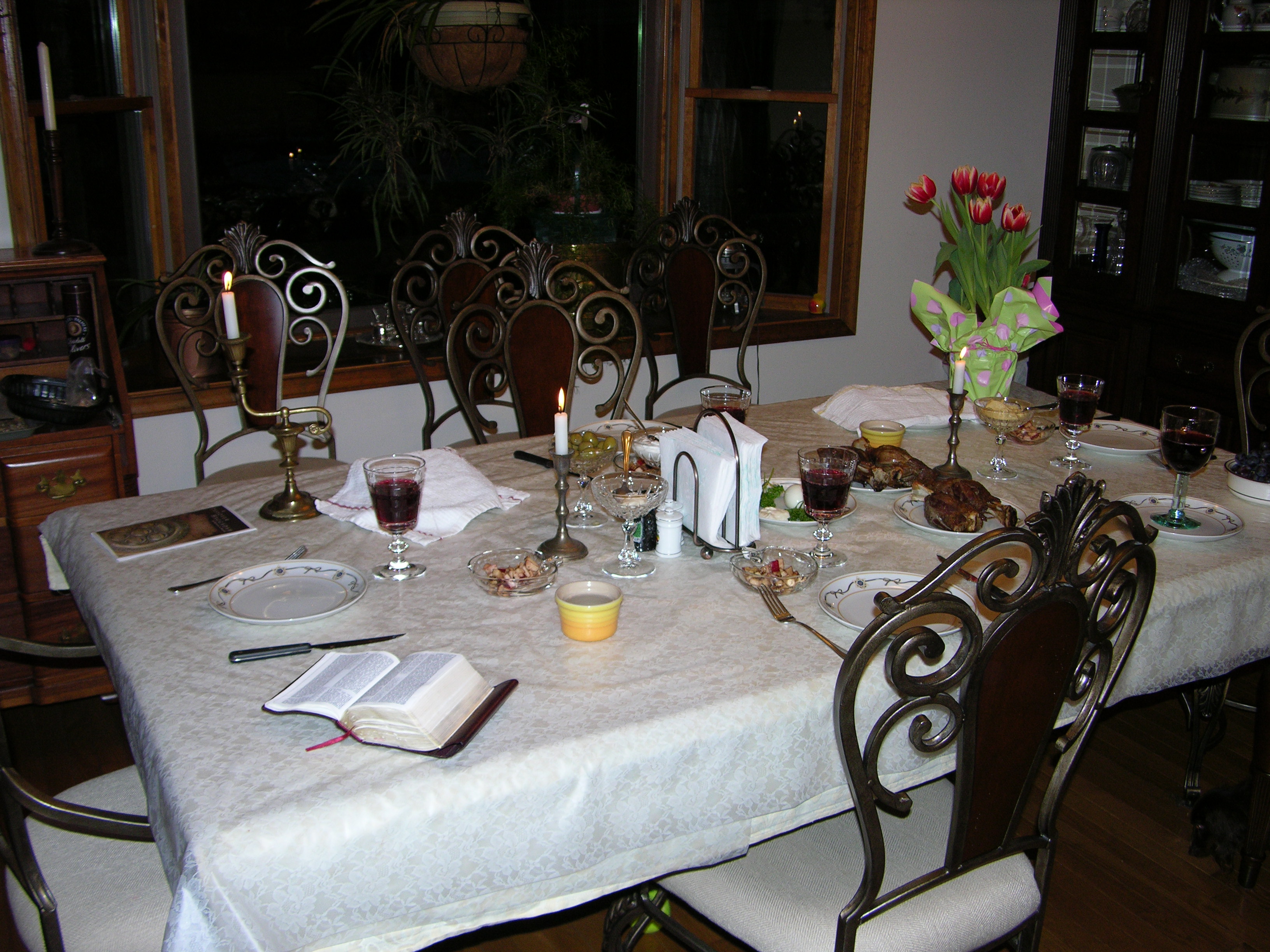
DSCN9056

My family sat down Monday evening, when Passover began at sundown, and we took communion after we read the original Passover passage in Exodus 12.  In Matthew Chapter 26, we see Jesus sitting down with His disciples to celebrate this same feast.  During this most important ‘Last Supper’ celebration, Jesus took some of these same Seder items and began to correlate them to Himself and the work God had given Him to accomplish.  Luke records these words, “Do this in remembrance of Me.”[5]

We began to feast on some roasted lamb and the bitter herbs and other things on the Seder menu.  My meal was by no means kosher but most of those rules are man-made and not in the original passage in Exodus 12.  I didn’t throw out all of my bread, crackers or food items that contained leaven.  Most of the processed foods today, such as pasta, cereal, chips etc. may contain some sort of leavening agent and I would have to be a chemist to understand this all fully.  I would also have to dump a huge portion of our food items.  The sheer financial impact of that act would be impossible for me to shoulder right now.  Taking them out of the house and asking someone to keep them for me till the feast period is over seems to be cheating the original text, in my opinion.

The old leaven God was bringing into focus to the people of that day was a way to present a visual image of sin – not just the existence of yeast.  My prayer over our meal was for Holy Spirit to rid me of the real leaven…the unforgiveness, the complaints, the slander, the fear, the bitterness and anger that strife and conflict often breeds.  These are the real issues that can separate me from God and from others.  It is so important to remember who Jesus is and where Jesus was born.

Here are my notes and the word studies that helped me:

1.  The first Passover in Exodus 12 is a shadow of what Jesus would do when He died on the cross.  Remember Revelation 13:8…Jesus was slain from the foundation of the world.  Jesus was also loved from the foundation of the world as we see in  John 17:24.  He knew He was going to die before He ever began His public ministry…”The reason My Father loves Me is that I lay down My life – only to take it up again.  NO one takes it from Me, but I lay it down on My own accord.[6]

2.  It was the High Priest’s duty to kill and sacrifice the sin offering – this is very important to understand (Leviticus 9:1-11).

3.  What the first Passover provided:  Psalm 105:37-45

a. Escape from the death angel – Exodus 12:12-30; a call for a lasting ordinance between God and His people

b. Freedom from slavery and bondage – Exodus 12:40-42; Exodus 13:14-16

c. Everyone was strengthened, even the elderly; no one was sick or infirm; Psalm 105:37

d. He was a light and a covering from the weather/heat

e. Their clothes did not wear out

f.  He provided food and water everywhere they went

g. They received a new inheritance…a future and a hope.

h. They spoiled the Egyptians and they came out wealthy…payback for the 430 years of slavery and stolen wages.

4.  In John 2:13, Jesus is in Jerusalem for the Passover and to become the fulfillment of the Passover.  He is mad because He sees the people being cheated; the lambs they bring are acceptable to God.  However, the Temple priests won’t accept the lambs from the people but demand that the people buy ‘approved’ lambs from the Temple flocks.  The money changers and animal sellers make money off the trades/exchanges (John 10:7).

5.  Jesus declares, “I AM the door of the sheep; in Jerusalem, the sheep gate was the entrance in the northeastern corner of Jerusalem’s city wall (see Neh. 3:1, 12).  Apparently, sheep for the Temple sacrifice entered the city through it.  It was close to the Pool of BethesdaRead John 5:1-9 to see a picture of what Jesus came to accomplish in us.

6.  Bethlehem means ‘House of Bread’.  The Bread of Life was born in the house of bread.  Bethlehem – Strong’s No. 1035 (Hebrew) from bayith (1004) means ‘house’; and 3899 ‘lechem means ‘bread’.  See (Exodus 25:30).

Bethlehem was also the holding ground for all the sheep being brought into Jerusalem and sold at the Temple for sacrifice during the Feasts of the Lord (Deuteronomy 16:1-17).  Approved and acceptable Temple sacrificial lambs were raised by shepherds on the hills of Bethlehem.

7.  John 1:29 John the Baptist declared Jesus, “the Lamb that takes away the sin of the world.”  He did this since the priesthood had not done so as they should.

8.   God says, “These are MY appointed feasts.”Leviticus 23:1-44 (note: vs. 14, 21):

a.  The Sabbath – 6 days you may work, but the 7th day is a Sabbath of rest; a day of sacred assembly.  Our Saturday is the Sabbath.  Sunday is the first day of the week.

b.  The Passover – on the 14th day of the first month; it begins at twilight.

c.  The Feast of Unleavened Bread – on the 15th day of the first month – 7 days no bread made with yeast.

d.  First Fruits – bring the first from your harvest to the priests on the day after the Sabbath (our Sunday)- the 3rd day after Passover.

eFeast of Weeks – Pentecost – count off 50 days from the 7th Sabbath of the first month (7 full weeks from Passover).  Pente means ‘50’ and it celebrates God giving the Ten Commandments to Moses on the mountain.

f.  The Feast of Trumpets – the first day of the 7th month.

g.  The Day of Atonement – from sundown on the 9th day until sundown on the 10th  day of the 7th month – a solemn time of fasting, personal examination of sin;  it is the most holy day of the year.  It is also a Sabbath rest day.

h.  The Feast of Tabernacles – the 15th day of the 7th month – this feast lasts for 7 days.  No work is to be done during this week; on the 8th present an offering to the Lord at the sacred assembly.  Live in booths (Let’s go camping – oh yeah!).

9.  Jesus is The Fulfillment of The Lord’s Feasts:

aIn death, Jesus rested on the Sabbath.  He was buried before sundown on Good Friday (His crucifixion day).  Jesus arose from the grave on the first day of the week (our Sunday).    Matt. 28:1-10; Mark 16:9-20 (note Acts 28:3-6);  Luke 24:1-8; 44-49; John 20:1.

b.  Jesus celebrates His last Passover, introduces Communion and becomes the Passover Lamb for the sin of the world;  Luke 22:1-13; John 13:1, John 18:28-40; John 19:10-12; John 19:31-37; He is buried before sundown, as the Passover feast begins for the nation of Israel -John 19:42.  See I Corinthians 5:6-8,  Revelation 13:8b

c.  Jesus, the sinless Bread of Heaven introduces His body as the Unleavened Bread sacrifice.  John 6:48-63 and Matthew 26:28.  Leviticus 2:4-11; Mark 8:15, I Cor. 5-7-8; Galatians 5:9.

d.  Jesus, first born among the dead, Romans 8:23, I. Corinthians 15:20-23;I Cor. 15:20-26, James 1:18; Romans 11:11-29.  Key on verse 29!  

e.  Jesus breathes on the 11 remaining disciples and tells them ‘receive the Holy Spirit’. (John 20:19-20; Luke 24:45-49 – “tarry in the city until you have been clothed with power from on high”.  Acts 2:-5; Acts 2:1-4; The Holy Spirit comes with power on the 120 waiting per Jesus’ final instructions in Luke and John.  This event happens on the Feast of Pentecost, 50 days after Jesus was crucified.

f.  The Feast of Trumpets – the blowing of trumpets – all day.  I. Thessalonians 4:14-18 (the rapture of the church –  unfulfilled); Zechariah 9:14; Zechariah 14:1-9; Matthew 24:30-31

g.  Atonement – Rosh Hashanah; Final judgment, the Book of Life opened – unfulfilled (Rev. 20:11-15).

h.  The Feast of Tabernacles – God makes His dwelling with us (Rev 21)– unfulfilled – Jesus kept this feast; He declared Himself to be the Living Waters that would be in us, streams of living water; John 7:1-41;Zechariah 14:16-20.  Parable of the Great Banquet:  Luke 14:15- 23.

i.  Jesus – Strong’s Hebrew 3091[from 3068 Yehovah – the self-Existent or Eternal; Jehovah, Jewish national name of God, Jehovah, the Lord; and 3467 yasha (yaw-shah) to be open – wide or free; to be safe, cause to free or succor; avenging, defend, deliver or deliverer, help, preserve, rescue, be safe, bring salvation, save or savior, get victory.  Jesus – Strong’s Greek 2424.


[1] Matthew 22:1-14.; “The Comparative Study Bible – New International Version ,” copyright 1999; Zondervan; Grand Rapids, Michigan; pages 2491 and 2493.

[2] Zechariah 14:1-21, ibid; pages 2411 and 2413.

[3] I Corinthians 5:7-8; ibid, page 2917.

[4] Luke 1:67-79; ibid, pages 2589 and 2591.

[5] Luke 22:7-20; note verse 19; ibid, pages 2673 and 2675.

[6] John 10:14-18; ibid, page 2727.