Posts Tagged ‘hope’

January 02-14, 2015

cautioncropJan 10 2015 012 The voice comes as the problems mount. You are in that place of waiting. The Deceiver of circumstances wants you to agree…nothing will ever change…the job won’t come…the bills are unpaid…the sickness won’t go away…it is too late…no one will ever pay any attention…you are forgotten by God. It is a place where your emotions are so brittle it only takes a cross look to make you weep – or sometimes simply a kind word.

Everyone else seems to be doing well. They work, they prosper, they build, they plant, they travel, they share their energetic moments with such zeal; and they seem to think that the rest of the world is just as elated. “Why can’t you get it together,” their eyes silently ask, as their unspoken question stands just out of earshot. I know. I’ve been on both sides of the conversation.

Silencing the Mouth of Doom

David the shepherd, David the warrior, David the future king of Israel intimately knew such a place, as he ran and hid from the wrath of Saul the reigning king of Israel.(1)  David ran for his life for almost 15 years. He learned how to talk to himself in those impossible moments. “Why are you downcast, O my soul? Why so disturbed within me? Put your hope in God, for I will yet praise Him, my Savior and my God.”(2)

Statements like these are one of the reasons that David’s writings in the Psalms are so enduring – they document and help comfort. The Psalms lighten the burden of waiting – and the place of brokenness – which is part of the human experience.

“I cry out to God Most High, to God who fulfills His purpose for me. He sends from heaven and saves me, rebuking those who hotly pursue me; God sends His love and His faithfulness.”(3)

Moses, Abraham and just about everyone of merit mentioned in the scriptures, walked through these same soul conflicts. Even Jesus knew such a place. His friend Lazarus knew that place. Lazarus felt the sting of death, the betrayal of his body to overwhelming sickness; and the finality of the burial cloths. He surrendered to decay in the grave and the silence of Sheol. The sisters cried, as they watched the men roll the stone over the mouth of the cave, locking their beloved brother away from the world. “Jesus, if you had only been here, our brother would not have died!”(4)

signcropJesus saw their tears, their frustration with His inaction…their disappointment in His response. The text makes it clear He knew that Lazarus’ sickness would not end in death. He wept, I think, not only for his dead friend, but mostly for their broken heartedness towards Him and the Father’s delay plan. He only did what His Heavenly Father said to do…He only moved when His Father said “go”.(5)  He felt their pain, their frustration – and even their anger.

“Take away the stone,” He said.
“But Lord,” said Martha, the sister of the dead man, “by this time there is a bad odor, for he has been there four days.”
“Then Jesus said, “Did I not tell you that IF you believed, you would see the glory of God?” So they took away the stone. Then Jesus looked up and said, “Father, I thank you that you have heard me. I knew that you always hear me, but I said this for the benefit of the people standing here, that they may believe that you sent me.” When He had said this, Jesus called out in a loud voice, “Lazarus, come out!”
The dead man came out, his hands and feet wrapped with strips of linen, and a cloth around his face. Jesus said to them, “Take off the grave clothes, and let him go.”(6)

Why did God wait? It was only in the totality and the stench of death that God’s resurrection power could be properly revealed. Resurrection is an interesting word found only in New Testament writings. All of the gospel writers (Matthew, Mark, Luke and John), as well as Paul and the writer of Hebrews, grasped the unusual concept often debated among the Jewish religious sects.

[G#386 anastasis (an-as-tas-is) a standing up again; literally from death; or figuratively, a moral recovery of spiritual truth; from G#450](7)
[G#1454 egersis (eg’-er-sis) a resurgence (from death); a rousing; used in Matthew 27:53 regarding Jesus’ resurrection](8)
[G#1815 exanastasis (ex-an-as’-tas-is) resurrection; a rising from death; from G#1817](9)

The Apostle Paul knew that place of trauma, waiting and frustration; and it is a dark night of the soul. His painful words to his spiritual son Timothy document this moment, as he languished in a Roman prison: “Even Demas has deserted me…and at my first defense, no one came to my support, but everyone deserted me. May it not be held against them. But the Lord stood at my side and gave me strength, so that through me, the message might be fully proclaimed and all…might hear it.”(10)

curve left cropJan 10 2015 003Learning To Share The Cup

Between the Old and New Testaments, the condition of the heart (i.e. the contents and actions coming out of the heart of man) is discussed almost a 1000 times! Jesus discussed this crucial subject over 45 times. The Hebrew word for heart first shows up in Genesis at an ominous place – just before the flood of Noah’s day.

“When men began to increase in number on the earth…the Lord saw how great man’s wickedness on the earth had become, and that every inclination of the thoughts of his heart was only evil all the time. The Lord was grieved that He had made man on the earth and HIS HEART was filled with pain.”(11)

watercrop Jan 10 2015 007Another telling fact makes its first appearance in scripture: God was grieving over the way His creation had turned out. God was feeling such pain He had to take drastic actions. I personally think the massive downpour that covered the face of the earth, once the fountains of the deep broke open, just may have been the very tears of God.

[H# 3820 leb (labe) the heart; also used (figuratively) very widely for the feelings, the will and even the intellect; likewise for the centre of anything.](12)
[H# 6087 ’atsab (aw-tsab’) properly, to carve; i.e. fabricate or fashion; hence (in a bad sense) to worry, pain or anger; displease, grieve, hurt, make, be sorry, vex, worship, wrest](13)

Several thousand years later, new parents Mary and Joseph brought baby Jesus up for dedication. The prophet Simeon took him from Mary’s arms and said: “This child is destined to cause the falling and rising of many in Israel, and to be a sign that will be spoken against, so that the thoughts of many hearts will be revealed. And a sword will pierce your own soul too.”(14)

Pain is never wasted by God. The question becomes, just like Jesus asked the disciples (who were jockeying for position around His future throne in glory): “Will you indeed share My cup?”(15) His cup was a chalice of pain, suffering and death on a cruel Roman cross. Historical records show that most of the disciples suffered extensively and died for their faith in the deity of Jesus.

stopcropJan 10 2015 010What is God doing through these times of great adversity? God is not wasting the circumstances. He uses these situations to search our heart and examine our mind – and He digs deep.(16) He already knows what’s there, He just wants us to see the depth of our need for Him, and His plans and His ways; and for us to come into agreement with Him. He promises that “in” all things, He is working for our good.(17) He also uses these opportunities to show us His glory. Just like in Lazarus’ story, it took death to showcase God’s resurrection power.

The Real Prodigals

What is God after? For one thing, I believe He’s after the conversations we have with ourselves deep in our own heart.

1. In the day of my trouble I sought the Lord…I complained and my spirit was overwhelmed…I call to remembrance my song in the night; I commune with mine own heart…Is His mercy clean gone forever?(18)
2. The fool says in his heart, “There is no God.”(19)
3. If we had forgotten the name of our God or spread out our hands to an [idol], would God not have discovered it, since He knows the secrets of the heart?(20)
4. Blessed are the pure in heart…(21)
5. Where your treasure is there your heart will be also.(22)
6. For out of the overflow of the heart the mouth speaks. The good man brings good things out of the good stored up in him, and the evil man brings evil things out of the evil stored up in him.(23)
7. One of them, an expert in the Law, tested Him [Jesus] with this question: Teacher, which is the greatest commandment in the Law?” Jesus replied, “Love the Lord your God with all your heart and with all your soul and with all your mind.  This is the first and greatest commandment. And the second is like it: Love your neighbor as yourself. All the Law and the Prophets hang on these two commandments.”(24)
8. This then is how we know that we belong to the truth, and how we set our hearts at rest in His presence, whenever our hearts condemn us. For God is greater than our hearts and He knows everything.(25)

intersectioncropJan 10 2015 032We all have to face those moments in life when we don’t understand God’s actions. It is at these strategic inflection points of life that we choose how we will respond to the concept of God as our Heavenly Father. Those who have known the truth of God’s love and His ways, yet they choose to walk away and abandon their previously held convictions – they remain the hardest to understand and reach.

“Suppose one of you has a hundred sheep and loses one of them. Does He not leave the ninety-nine in the open country and go after the lost sheep until He finds it?”(26)

In some respects, I believe, the refining fire of trust; or the stress and weight of the waiting was too much. Or maybe just like Lazarus, their flesh betrayed them – and they died to their previous way of believing in God’s plans for their lives. Maybe like Martha and the mourners, they became impatient and angry… “Lord, if YOU had been here…none of this would have happened.” Like Mary, maybe they don’t even respond anymore, when they hear of the nearness of Jesus.

However, it is in these fiery moments when the beauty of pure trust is refined and polished by His loving hands. I believe this kind of trust is the purest form of worship offered up to God. Jesus promised to go after the real prodigals. I know. He went after me in 1987.

curvy road cropJan 10 2015 026

Elpizo – Hope and Trust

The Old Testament story of Job documents his incredible season of adversity.  After 37 chapters of feeling sorry for himself, Job finally replied: “Yeah though You slay me, still I will trust You.”(27)

How should we respond? TRUST! Over and over again, this key issue is presented by and through life events to every man and woman. Our nation was founded on these same seasons of adversity and the belief that God was behind the creation of a nation that would allow mankind to have this conversation with God without the use of force. In 1864, the phrase “In God we trust” first appeared on US coinage.(28) Our nation chose to make this scriptural declaration official in 1956, and began printing or minting this phrase on the very foundation of our commerce – all American currency. I think it is interesting that this simple scriptural phrase has made it to almost every corner of the earth because of US currency.

[Greek # 1679 elpizo (el-pid-zo) from G#1680; to expect or confide; hope, trust](29)

Theos Elpis – The God of all Hope – At Work

The Apostle Paul gave us a powerful secret: trust like this steps over the line of the impossible and becomes a powerful, living force called HOPE – especially when our focus is on the God of Abraham, the God of the Bible, the Eternal One Jesus came to reveal in all of God’s fullness.

“May the God of all Hope [Theos ho Elpidos – the God of the expectation] fill you with all joy and peace as you trust in HIM – so that you will overflow with hope by the power of the Holy Spirit.”(30)
“And the peace of God, which surpasses all understanding, WILL guard your hearts and minds through Christ Jesus.”(31)

[Greek # 1680 elpis (el-pece) expectation or confidence – faith, hope!](32)

Right arrow cropJan 10 2015 022

Additional Study Notes:

Jesus said to them, “My Father is always at His work to this very day, and I too, am working….by Myself, I can do nothing…for I seek not to please Myself but Him who sent Me.”(33)

“For it is God who is at work in you; both to will and to work for His good pleasure.”(34)

Some things done in/to the heart :
• thoughts of the heart (Genesis 6:5)
• said (say) in His heart (Genesis 8:21)
• laugh in his heart (Genesis 17:17)
• set his heart (Ex. 7:23)
• judgment upon his heart (Ex. 28:29)
• seek God with all your heart (Deut. 4:29)
• consider it in your heart (Deut 4:39)
• love the Lord with all your heart (Deut. 6:5)
• serve Him with all your heart (Deut. 11:13)
• to turn away in your heart (Deut 17:17)
• to keep and do with all your heart (Deut 26:16)
• to fear in heart (Deut. 28:67)
• to walk in the imagination of your heart (Deut. 29:19)
• to allow God to circumcise your heart (Deut. 30:6)
• great thoughts of the heart (Judges 5:15)
• great searchings of the heart (Judges 5:16)
• to tell or show all of your heart (Judges 16:18)
• to whisper or speak only in your heart (I. Samuel 1:13)
• to rejoice in your heart (I Samuel 2:1)
• **God changes Saul’s heart (I Samuel 10:9)
• **God searches out a man after His own heart (I. Samuel 13:14)
• laid up these words in his heart (I. Samuel 21:12)
• she despised him in her heart (II Samuel 6:16)
• to take a thing to heart (II Samuel 13:33)
• to bow or subdue the hearts of others (II Samuel 19:14)

Interesting heart conditions:
• grieved in heart (Genesis 6:6)
• evil heart (Genesis 8:21)
• integrity of my heart (Genesis 20:5)
• hearts failed them (Genesis 42:28)
• glad in heart (Ex 4:14)
• hardened in his heart (Ex 4:21; Ex. 7:3)
• cause sorrow of the heart (Leviticus 26:16
• discouraged in heart (Numbers 32:9)
• obstinate in heart (Deuteronomy 2:30)
• uprightness of heart (Deut 9:5)
• deceived in heart (Deut 11:16)
• to be hot in heart; i.e. in the act of slaying someone (Deut 19:6)
• blindness and astonishment of heart (Deut. 28:28)
• joyfulness and gladness of heart (Deut. 28:47)
• trembling heart (Deut 28:65)
• a heart to perceive (Deut. 29:4)
• a heart that has melted (Joshua 5:1)
• comforted in heart (Judges 19:5)
• merry in heart (Ruth 3:7)
• in the naughtiness of thine heart (I Sam 17:28)
• an offended heart (I Samuel 25:31)
• to have the heart of a lion (II Samuel 17:10)
• the king’s heart was toward his son (II Samuel 13:33)
• heart in anguish (Ps 55:4 ) – H2342 chuwl (khool); to twist or whirl (in a circular or spiral manner); i.e. (specifically) to dance, to writhe in pain (especially of parturition – childbirth) or fear; fig; to wait, to pervert, to bear, to make bring forth, to calve, dance, drive away; fall grievously (with pain), etc.

Endnotes:

(1) I Samuel 15-31; “The Comparative Study Bible – The New International Version”; copyright 1999; Zondervan Publishing; Grand Rapids, MI; pages 735-781.
(2) Psalm 41:5-6; “The Comparative Study Bible – The New International Version”; copyright 1999; Zondervan Publishing; Grand Rapids, MI; page 1427.
(3) Psalm 57:2-3; “The Comparative Study Bible – The New International Version”; copyright 1999; Zondervan Publishing; Grand Rapids, MI; page 1449.
(4) John 11:1-44; “The Comparative Study Bible – The New International Version”; copyright 1999; Zondervan Publishing; Grand Rapids, MI; pages 2729-2733.
(5) John 5:16-30; “The Comparative Study Bible – The New International Version”; copyright 1999; Zondervan Publishing; Grand Rapids, MI; page 2705.
(6) John 11:17-44; “The Comparative Study Bible – The New International Version”; copyright 1999; Zondervan Publishing; Grand Rapids, MI; pages 2731-2733.
(7) Greek #386 anastasis; “The New Strong’s Exhaustive Concordance of the Bible”; Strong; James, LL.D.,S.T.D; copyright 1995,1996; Thomas Nelson Publishers; Nashville, TN; page 7.
(8) Greek #1454 egersis; “The New Strong’s Exhaustive Concordance of the Bible”; Strong; James, LL.D.,S.T.D; copyright 1995,1996; Thomas Nelson Publishers; Nashville, TN; page 25.
(9) Greek # exanastasis; “The New Strong’s Exhaustive Concordance of the Bible”; Strong; James, LL.D.,S.T.D; copyright 1995,1996; Thomas Nelson Publishers; Nashville, TN; page 32.
(10) II Timothy 4:9-18; “The Comparative Study Bible – The New International Version”; copyright 1999; Zondervan Publishing; Grand Rapids, MI; pages 3073-3075.
(11) Genesis 6:1-8; “The Comparative Study Bible – The New International Version”; copyright 1999; Zondervan Publishing; Grand Rapids, MI; page 15.
(12) Hebrew #3280 leb; “The New Strong’s Exhaustive Concordance of the Bible”; Strong; James, LL.D.,S.T.D; copyright 1995,1996; Thomas Nelson Publishers; Nashville, TN; page 68.
(13) Hebrew #6087; “The New Strong’s Exhaustive Concordance of the Bible”; Strong; James, LL.D.,S.T.D; copyright 1995,1996; Thomas Nelson Publishers; Nashville, TN; page 109.
(14) Luke 2:21-35; “The Comparative Study Bible – The New International Version”; copyright 1999; Zondervan Publishing; Grand Rapids, MI; page 2593.
(15) Matthew 20:20-28; “The Comparative Study Bible – The New International Version”; copyright 1999; Zondervan Publishing; Grand Rapids, MI; page 2487.
(16) Jeremiah 17:5-10; “The Comparative Study Bible – The New International Version”; copyright 1999; Zondervan Publishing; Grand Rapids, MI; page 1937.
(17) Romans 8:28; “The Comparative Study Bible – The New International Version”; copyright 1999; Zondervan Publishing; Grand Rapids, MI; page 2883.
(18) Psalm 77:1-8 paraphrased; The Comparative Study Bible – King James Version”; copyright 1999; Zondervan Publishing; Grand Rapids, MI; pages 1478-1480.
(19) Psalm 53:1; “The Comparative Study Bible – The New International Version”; copyright 1999; Zondervan Publishing; Grand Rapids, MI; page 1443.
(20) Psalm 44:21; “The Comparative Study Bible – The New International Version”; copyright 1999; Zondervan Publishing; Grand Rapids, MI; page 1431.
(21) Matthew 5:8; “The Comparative Study Bible – The New International Version”; copyright 1999; Zondervan Publishing; Grand Rapids, MI; page 2435.
(22) Matthew 6:21; “The Comparative Study Bible – The New International Version”; copyright 1999; Zondervan Publishing; Grand Rapids, MI; page 2439.
(23) Matthew 12:34-35; “The Comparative Study Bible – The New International Version”; copyright 1999; Zondervan Publishing; Grand Rapids, MI; page 2459.
(24) Matthew 22:36-40; “The Comparative Study Bible – The New International Version”; copyright 1999; Zondervan Publishing; Grand Rapids, MI; page 2495.
(25) I John 3:19-20; “The Comparative Study Bible – The New International Version”; copyright 1999; Zondervan Publishing; Grand Rapids, MI; page 3161.
(26) Luke 15:3-7; “The Comparative Study Bible – The New International Version”; copyright 1999; Zondervan Publishing; Grand Rapids, MI; page 2649.
(27) Job 13:15; “The Comparative Study Bible – The New International Version”; copyright 1999; Zondervan Publishing; Grand Rapids, MI; pages 1307.
(28) “In God We Trust”; http://en.wikipedia.org/wiki/In_God_we_trust ; accessed January 14, 2015.
(29) Greek #1679 elpizo; The New Strong’s Exhaustive Concordance of the Bible”; Strong; James, LL.D.,S.T.D; copyright 1995,1996; Thomas Nelson Publishers; Nashville, TN; page 29.
(30) Romans 15:13; “The Comparative Study Bible – The New International Version”; copyright 1999; Zondervan Publishing; Grand Rapids, MI; page 2901.
(31) Philippians 4:7; “The Comparative Study Bible – The New International Version”; copyright 1999; Zondervan Publishing; Grand Rapids, MI; page 3023.
(32) Greek #1680 elpis; “The New Strong’s Exhaustive Concordance of the Bible”; Strong; James, LL.D.,S.T.D; copyright 1995,1996; Thomas Nelson Publishers; Nashville, TN; page 29.
(33) John 5:16-30; “The Comparative Study Bible – The New International Version”; copyright 1999; Zondervan Publishing; Grand Rapids, MI; page 2705.
(34) Philippians 2:13; “The Comparative Study Bible – The New International Version”; copyright 1999; Zondervan Publishing; Grand Rapids, MI; page 3019.

July – November, 2014

One of the most interesting characters introduced in Old Testament writings is a man named Abraham.  He can trace his lineage all the way back to Shem, the youngest son of Noah.  Noah was the well known builder of the ark (which brought safety to their family and all the living creatures sent to ride out the historic flood of the entire earth).  Abraham’s story starts up in the 12th chapter of Genesis, and understanding his life experience helps provide the backdrop needed to understand his big problem.(1)

His name, at this point in the story, is Abram (which means ‘father is exalted’).  Biblical name meanings were very significant.  Later on in Abram’s life, God changed his name to Abraham (which means ‘father of a multitude’).

“Abram was born into a well off family from the prominent city of Ur, found in ancient Mesopotamia (a site in modern day Iraq, about 220 miles southeast of Baghdad).(2)  The culture of Abram’s day was highly advanced, with large, middle class stone/brick homes featuring multiple floors and 10-20 rooms.  Some of the homes featured chapels, and guest chambers with lavatories.(3)  Archeological excavations of this area have revealed a school where students studied by use of clay tablets, which communicated lessons in reading, writing, arithmetic (with tablets focusing specifically on multiplication and division tables, and square and cube root workings).  A 2040 B.C. bill of lading showed that commerce of that time was far reaching.”(4)

Abram’s father, Terah, moved the family from Ur to a city named Haran, located in northern Mesopotamia along the river Balikh.(5)  The family originally intended to move to the land of Canaan, but when they got to the city of Haran, they stopped.  Terah had a first born son named Haran, who died before the family left Ur, so it is possible that the name of the city held certain emotional sway over Terah’s decision.  At this point, Abram and his other brother, Nahor, were grown and had wives of their own.  Abram’s wife was Sarai, a woman noted for her incredible beauty.  Sarai, for all her beauty, also had a big problem for her day.

Abram’s many adventures included his personal encounter with “Jehovah” God (the Hebrew name used for God when He revealed Himself to individuals in the Old Testament).  After Terah’s death, Abram (at God’s leading), took his family and set out for the land of Canaan once again, with God’s promise to “…make Abram into a great nation by blessing Abram, and blessing those who blessed him – and cursing those who cursed him…”(6)  Abram was 75 years of age at this time.  Sarai was 65.

The nomadic family made their first documented stop near the town of Bethel (which means ‘house of God’). There Abram built an altar, seeking the manifest presence of Jehovah God once again.  A famine arose in the land, which caused Abram to move the family to Egypt; and out of fear, he ordered his wife to tell everyone she was his sister (which is not a full lie, she was his half-sister from Terah’s son, Haran). The woman must have been flat out fine, because even at the age of 65, Sarai’s beauty attracted the attention of the Egyptians, and she wound up in the harem of Pharaoh.  God intervened on her behalf and inflicted some terrible diseases upon the the ruler and his household, until they figured out Abram’s deception, and let her go back to her husband.

This event happened again much later in their lives, and she wound up in the possession of Abimelech, king of Gerar.  God caused barrenness to come upon all of the women of the king’s household as punishment.  Finally God spoke to the king in a dream and told him of Abram’s duplicity; and the next morning, the king released her to her husband, along with a 1000 pieces of silver, sheep, cattle, etc.  The king also gave them permission to live any where in his lands.

Abram’s nephew Lot had tagged along with his Uncle Abram up to this point, and he too had prospered under ‘the blessing of God’.  His herds experienced much increase as well.  The two families finally had to separate because the herds were too big for the grazing areas.  Lot took his wife, children, livestock and herdsmen, and headed for the lush plains of the decadent city of Sodom.  This decision proved to be quite disastrous for Lot and his family.  They were ambushed and taken captive by a group of feudal kings battling it out for tribal supremacy in the verdant plains.  Abram rushed into the fray and rescued his nephew and family; and then he presented the spoils of war as an offering through the mystery king of Salem called Melchizedek.  Melchizedek was also a priest of God Most High.  After this offering, Abram went back to his home, and one night the word of the Lord came to Abram in a vision.

Do not be afraid, Abram. I am your shield, your very great reward.”
“But Abram said, “O Sovereign Lord, what can you give me since I remain childless…You have given me no children; so a servant in my household will be my heir.”
“This man will not be your heir, but a son coming from your own body will be your heir,” the Lord replied. Then He took Abram outside and said: “Look up at the heavens and count the stars – if indeed you can count them.” Then He said to him, “So shall your offspring be.”(7)

At this point in the story, an incredible piece of truth is revealed: “Abram believed the Lord and He credited it to Abram as righteousness.[H#6666 tsadaqah (tsed-aw-kaw)]“(8)  This is a legal term…use of this word is of extreme importance to us – according to Genesis 15:6 – God treated that sort of faith as being equivalent to righteousness…in right standing; justified.  In accounting terms, God transferred Abram and his faith, onto the right hand side of His ledger book.”(9)

Abram’s story does not stop there.  His wife, Sarai, came up with her own plan to fix their childlessness: she wanted to use her maid servant as a surrogate mother.  The plan seemed good to 85 yr old Abram, and by his next birthday, Hagar bore him a son named Ishmael.  13 years passed.  Suddenly God showed up again, this time calling Abram into a covenant relationship with Him. [H#1285 briyth (ber-eeth’); a compact, covenant, league, confederacy](10) . God initiated actions for this new level of relationship, and God changed Abram’s name to Abraham. “…for I have made you a father of many nations”.(11)  God changed Sarai’s name too, to Sarah, which means “Princess”.

Shortly thereafter, God revisited Abraham and Sarah again; this time He sent three angelic visitors to announce His plans to fulfill His promise for a baby of their own, a son.  The Angel of the Lord said He would return about the same time in the following year, and Sarah would have a son.

Sarah was out of sight in the tent, and she was eavesdropping.  At the ripe old age of 89, even in all her fineness, she knew the condition of her own, barren body.  The revelation by the Angel of the Lord seemed so incredible, she burst out with laughter and spoke to herself, “After I am worn out and my master is old, will I now have this pleasure?”  The Angel of the Lord knew what Sarah had whispered to herself, and He challenged her unbelief.  Afraid, Sarah lied and said she didn’t laugh. The Angel of the Lord rejected her lie and called her out: “Yes, you did laugh.”(12)

The word here for laugh [H#6711 tsachaq (tsaw-khak’) to laugh outright (in merriment or scorn); to make sport of; mock](13) is quite interesting.  Her laughter was eruptive and spontaneous, an action she could not hold back.  Sarah was facing the facts of her geriatric state; she was old, and the idea of her being able to finally conceive a baby seemed utterly impossible.

The Angel’s response is sobering: “Is anything too difficult for the Lord?”(14)

One year later, Sarah gave birth to her own son, and Abraham christened him with the name Isaac (which means, he laughs).  Sarah finally owned up to her original unbelief and replied, “God has brought me laughter, and everyone who hears about this will laugh with me.  Who would have said to Abraham that Sarah would nurse children?  Yet I have borne him a son in his old age.”(15)

Fast forward to the Apostle Paul’s time: Abraham’s story is legendary

Abraham’s story is well known in New Testament writings.  The Apostle Paul makes some interesting observations about Abraham’s life and faith:

1. Abraham believed God, and it was accounted to him for righteousness; therefore, be sure that it is those who are of faith who are the sons of Abraham…that no one is justified by the law [given to Moses] before God is evident; for the righteous man shall live by faith.(16)

[G#4100 pisteuo (pist-yoo-’o) to have faith (in, upon, or with respect to, a person or thing); i.e. credit (by implication to entrust one’s spiritual well-being to Christ); believer, commit, put trust in](17)

[G#4102 pistis (pis’-tis) persuasion; i.e. credence; moral conviction, assurance, belief, believe, faith, fidelity](18)

[G#1342 dikaios (dik’-ah-yos) equitable; innocent, holy (absolutely or relatively); just, righteous](19)

2.  Against all hope, Abraham IN Hope believed…he faced the facts, especially in dealing with his own body…but he did it without weakening in his faith.  Abraham bowed down and believed the promise spoken by God.  His posture of worship put him in the manifest presence of God…knowing that God was able to produce the desired heir (a son) for Abraham, even if Abraham’s body was as good as dead at the age of 99.

Abraham was physically changed after this encounter.  He took his hope, mixed it with faith, and look at the results: He lived to be 175.  His wife Sarah, at the age of 89, was barren until God visited her and gave her strength to conceive.  At the age of 90 she gave birth to Isaac.  Abraham was 100 at that point.  After Sarah’s death (at the age of 127) Abraham took another wife (Keturrah) and through her, they had 6 other sons.  This does NOT sound like the body of a man who is as good as dead – and this was long before all the male enhancement drug commercials on TV.(20)

The key to this understanding was Abraham’s posture of worship.  Three words in this passage give this clue:

[G#5087 tithemi (tith’ay-mee) to place in a passive or horizontal posture, bow, commit, kneel down, ordain, purpose, settle, sink down, etc.](21)
[G#2713 katenanti (kat-en’-an-tee) directly opposite; down facing, etc](22)
[G#1680 elpis (el-pece’) expectation; confidence, faith, hope](23)

Fast forward to our time: Abraham’s response must be mine too!

My current season of life has been wrought with stress, upheaval and conflict too.  Since 2010, everything I leaned upon, with the exception of my hope in God, has shifted.  I’ve moved twice; the first time over 700 miles from our home in Florida, and then the second move, over 400 miles from our home in Virginia. The man I called husband for 19 years chose to walk away from our marriage and our family to pursue a path I never thought possible.  Watching his choices and the horrible effects they’ve had on me, my children and our financial stability has been appalling.  Legal conditions enabled the situation to linger long past even a reasonable length of time.  Like Abraham, I’ve tried to figure a way to fix this problem on my own.  Like Sarah, most of my attempts to relieve the pressure around me have caused greater conflict.  I had such great respect for all I saw God do in this man’s life prior to 2010.  Waves of shock and disappointment have been almost overwhelming.

In a place of brokenness and almost despair, I found a 3×5 index card I’d made of this scripture found in the 4th chapter of Romans.  It was dated August 7, 1992.  I’ve been making these cards since the late 1980s.  I picked up the habit from my father.  I found some of the same type cards in his personal things given to me back when I was in college in 1978.  I keep all my cards in a big picture storage box (looks like a nice shoe box).  I take one out daily and meditate on it; make notes that may be relevant to my life issues, and it eventually gets back into the box in no particular order.

I began to read the scripture passage aloud – and suddenly I had an epiphany: I had to fully face the facts of my situation, just like Abraham had to do in his day.  I cannot change my husband’s choices. The resolution to our situation is in the hands of lawyers and a judge.  I am not in control of their response or the end results.  However, in doing so, I do not have to waiver in my faith that good will come out of all of this conflict and disappointment.

I fell to my knees and began to weep – and suddenly I realized that holding back the tears was not necessary – they were part of my worship too.  I began to agree with Abraham’s prayer: God has power to do that which He promised.  In all things, He is working for my good.

Instead of meditating on my problems and the magnitude of the solution needed to bring real relief to me and my kids, I began to simply agree with Abraham: God, who gives life to the dead, and calls those things which do not exist as though they did, has the power to do that which He promised.(24) This became my food for thought – and my weapon of warfare every time the waves of fear and hurt came after me.  The despair and hopelessness began to break as I confessed my fears before the One who said to fear not!

Other revelations:

1.  God is the only source of hope that is sure – He is Theos Elpis – the God of hope.  His hope has power to bring change.

“May the God of Hope fill you with all joy and peace as you trust in Him so that you will overflow with hope by the power of the Holy Spirit.”(25)

2.   Hope has to be the anchor of our soul; it has to be mixed with full assurance of the goodness, the grace, the power and the justice of God.  It is this mixture of hope, assurance and faith that creates the foundation for God’s super in our natural. Abraham and Sarah hoped for a child. Until Abraham leaned his entire personality upon God and God’s ability, and he did this in a posture of worship, nothing changed. Hope by itself won’t change anything.(26)

20140831_154641

3.  “But as for me, I watch in hope for the Lord. I wait for God my Savior; my God will hear me.”(27)

[H# 6822 tsaphah (tsaw-faw) to lean forward, to peer into the distance; to observe, await; behold; espy, look up, wait for; keep the watch](28)
[H#3176 yachal (yaw-chal) to wait; to be patient; hope; cause to have or make to hope; be pained; stay, tarry, trust, wait](29)
[H#430 – elohiym (el-o-heem) your God of power and might; Creator God](30)
[H#3468 yesha’ (yeh’-shah); liberty, deliverance, prosperity, safety, salvation, saving](31)

4.  Blessed is the man who trusts in the Lord and whose hope is in the Lord.(32)

[H# 982 batach (baw-takh) – to hie for refuge; to trust, be sure or confident – be bold; careless (without care), put confidence, hope, trust](32)
[H#4009 mibtach (mib-tawkh’) a refuge; security, assurance, confidence, hope, sure, trust](33)

5.  I am still confident of this: I will see the goodness of the Lord in the land of the living.  Wait for the Lord, be strong and take heart and wait for the Lord.(34)

Endnotes**************************************************************

(1)  Harrison, R.K.; “Abraham”; “Holman Bible Dictionary”; copyright 1991; Holman Bible Publisher; Nashville, TN; page 10.
(2)  Fleming, David M.; “UR”; “Holman Bible Dictionary”; copyright 1991; Holman Bible Publisher; Nashville, TN; page 1385.
(3)  Excerpts from footnotes from Genesis 11:26 introduction of Terah, father of Abram; “The Comparative Study Bibe – The Amplified Version”: copyright 1999; Zondervan Publishing; Grand Rapids, MI; page 28.
(4)  Ibid; page 28.
(5)  Fleming; David M.; “Haran”; Holman Bible Dictionary”; copyright 1991; Holman Bible Publisher; Nashville, TN; page 605.
(6)  Genesis 12:1-9; “The Comparative Study Bible – The New International Version”; copyright 1999; Zondervan Publishing; Grand Rapids, MI; pages 29-31.
(7)  Genesis 15; ibid; page 37.
(8)  Hebrew # 6666 tsdaqah; “The New Strong’s Exhaustive Concordance of the Bible”; copyright 1995,1996; Thomas Nelson Publishers; Nashville, TN; page 119.
(9)  Zodhiates, Spiros; Th.D; Hebrew #6666 Tsdaqah; “Lexical Aids to the Old Testament”; “The Hebrew-Greek Key Word Study Bible”; copyright 1984, 1990 AMG International, Inc.; Chattanooga, TN; page 1768.
(10)  Hebrew #1285 byriyth; “The New Strong’s Exhaustive Concordance of the Bible”; copyright 1995,1996; Thomas Nelson Publishers; Nashville, TN; page 23.
(11)  Genesis 17:5; “The Comparative Study Bible – The New International Version”; copyright 1999; Zondervan Publishing; Grand Rapids, MI; page 41.
(12)  Genesis 17,18; ibid; pages 41-45.
(13) Hebrew #6711; tsachaq; “The New Strong’s Exhaustive Concordance of the Bible”; copyright 1995,1996; Thomas Nelson Publishers; Nashville, TN; page 120.
(14) Genesis 18:14; ibid; page 45.
(15) Genesis 21:1-7; ibid; page 51.
(16) Galatians 3:5-24; Zodhiates, Spiros; Th.D; “The Hebrew-Greek Key Word Study Bible”; copyright 1984, 1990 AMG International, Inc.; Chattanooga, TN; pages 1552-1555.
(17) Greek # 4100 pisteuo; “The New Strong’s Exhaustive Concordance of the Bible”; copyright 1995,1996; Thomas Nelson Publishers; Nashville, TN; page 120.
(18) Greek #4102 pistis; ibid; page 71.
(19) Greek #1343 dikaios; ibid; pages 23-24.
(20) Genesis 21-25; “The Comparative Study Bible – The New International Version”; copyright 1999; Zondervan Publishing; Grand Rapids, MI; pages 51-65.
(21) Greek #5087 tithemi; “The New Strong’s Exhaustive Concordance of the Bible”; copyright 1995,1996; Thomas Nelson Publishers; Nashville, TN; page 90.
(22) Greek # 2713 katenanti; “The New Strong’s Exhaustive Concordance of the Bible”; copyright 1995,1996; Thomas Nelson Publishers; Nashville, TN; page 48.
(23) Greek #1680 elpis; “The New Strong’s Exhaustive Concordance of the Bible”; copyright 1995,1996; Thomas Nelson Publishers; Nashville, TN; page 29.
(24) Romans 4:17-25; “The Comparative Study Bible – The New International Version”; copyright 1999; Zondervan Publishing; Grand Rapids, MI; page 2873.
(25) Romans 15:13; “The Comparative Study Bible – The New International Version”; copyright 1999; Zondervan Publishing; Grand Rapids, MI; page 2901.
(26) Hebrews 6:17-20; ibid; page 3097.
(27) Micah 7:7, 18-20; ibid; page 2355.
(28) Hebrew # 6822 tsaphah; ; “The New Strong’s Exhaustive Concordance of the Bible”; copyright 1995,1996; Thomas Nelson Publishers; Nashville, TN; page 122.
(29) Hebrew # 3176 yachal; ; “The New Strong’s Exhaustive Concordance of the Bible”; copyright 1995,1996; Thomas Nelson Publishers; Nashville, TN; page 56.
(30) Hebrew # 430 elohiym; “The New Strong’s Exhaustive Concordance of the Bible”; copyright 1995,1996; Thomas Nelson Publishers; Nashville, TN; page 8.
(31) Hebrew # 3468 yesha; ; “The New Strong’s Exhaustive Concordance of the Bible”; copyright 1995,1996; Thomas Nelson Publishers; Nashville, TN; page 61.
(32) Jeremiah 17:7; “The Comparative Study Bible – The New International Version”; copyright 1999; Zondervan Publishing; Grand Rapids, MI; page 1937.
(33) Hebrew # 982 batach; “The New Strong’s Exhaustive Concordance of the Bible”; copyright 1995,1996; Thomas Nelson Publishers; Nashville, TN; page 18.
(34) H#4009 mibtach; “The New Strong’s Exhaustive Concordance of the Bible”; copyright 1995,1996; Thomas Nelson Publishers; Nashville, TN; page 71.
(35) Psalm 27:13-14; “The Comparative Study Bible – The New International Version”; copyright 1999; Zondervan Publishing; Grand Rapids, MI; page 1403.

By Amy Hartmann

“How precious to me are Your thoughts, O God.  How vast is the sum of them!  Were I to count them, they would outnumber the grains of sand.  When I awake, I am still with You.”[1]

Dreams have prepared me for my future…

Dreams have reminded me of my past…

Dreams have been conversations – instigated by God – in the night watch.

As best I can remember, the first time God communicated with me in this particular way was the first week of December, 1978.  God spoke to me in the night, preparing me for my father’s sudden, accidental death on December 14, 1978.  It was my freshman year – and my first semester.  I was enjoying my new found liberty and responsibilities at a small private junior college in Lebanon, Tennessee.  God spoke and I listened.  I awoke, terrified and hysterical.  Back then, there were no cell phones or internet connections.  Dawn was breaking as I tumbled out of bed and began searching for enough change to make a pay phone call to my parents.  My roommate saw my panic and she hurried out of  bed to see what was wrong.  I quickly told her the dream as my tears fell.  I had to talk with my Dad.

A month after his funeral, in January of 1979, I had another dream about my brother in a car wreck.  I shared the dream with some school friends, as our college show choir traveled to my home town, to do a series of recruiting shows at numerous Chattanooga, TN high schools.  We were all riding in a van being driven by our college choir director.  Everyone knew of my earlier dream and they were all concerned with my grief load.  When we arrived in Chattanooga, we were met by my mother.  She was quite upset.  My choir director was out of the van first and he began to talk with my mother.  When I got out of the van, I was advised by our director, that my brother had indeed wrecked my mother’s car the night before.  Thankfully my brother escaped with no serious injury to himself, but the car was almost totaled.  Everyone in the van was amazed, because they all knew I had no way of knowing this information.

Now days everyone is texting and snap chatting every single minute of their lives, but in December of 1978, there were only occasional pay phone calls when we had enough change to spare.  At this point, my choir friends were in agreement with me that something strange was going on in my sleep.

As the years progressed, I began to keep track of my dreams, as I encountered the future in my sleep.  Dreams caused me to pick up the dusty Bible on the floor in my closet and carry it with me on my work trip to Leiden, Holland in 1987.  Dreams stirred me out of my complacent, self-centered life style when I was working in Acton, England in 1988.  Dreams caused me to examine, again, what the word of God had to say on this subject.

It is still interesting to me that the Book of Daniel was my random selection when I restarted my long neglected habit of reading the Bible.  It was February of 1987 when I made this choice, while I was sitting in my quiet hotel room in City Hotel, Leiden – Holland.  The entire book tracks the rise of a young, aristocratic, Hebrew teenage slave named Daniel, who found himself deported to the magnificent halls of the King of Babylon sometime in the Sixth Century, B.C.  He eventually spent much of the next 60 years as an advisor to the various rulers of the Babylonian empire and its ensuing conquerors.  Daniel’s narrative also documents some amazing and deeply disturbing prophetic, futuristic dreams.

The Bible is full of dreamers and the message they share is very clear: “…being warned of God in a dream…” people took action.[2]

Taking this key advice to heart, I began to seriously document my dreams in early 1990.  I made footnote references and logged dream dates and content in the blank pages in the back of my Bible.  Soon those pages were full and I took up dream journaling on tablets and spiral binders.  My book shelf is full of these diary-like notebooks.  Sometime in 2008 I took up daily prayer journaling.  It was at this time I began in earnest to correlate life events with my dreams.

In early 2009 my sleep took on another form of revelation: I began to feel the earth shake.  At first, I awoke to a shuddering feeling, as I heard the ground groan underneath our Jacksonville home.  Fearful of this event, I woke my sleeping husband, warning him of the earthquake underway.  He looked at me for a few moments, he said he felt nothing and then he went back to sleep.

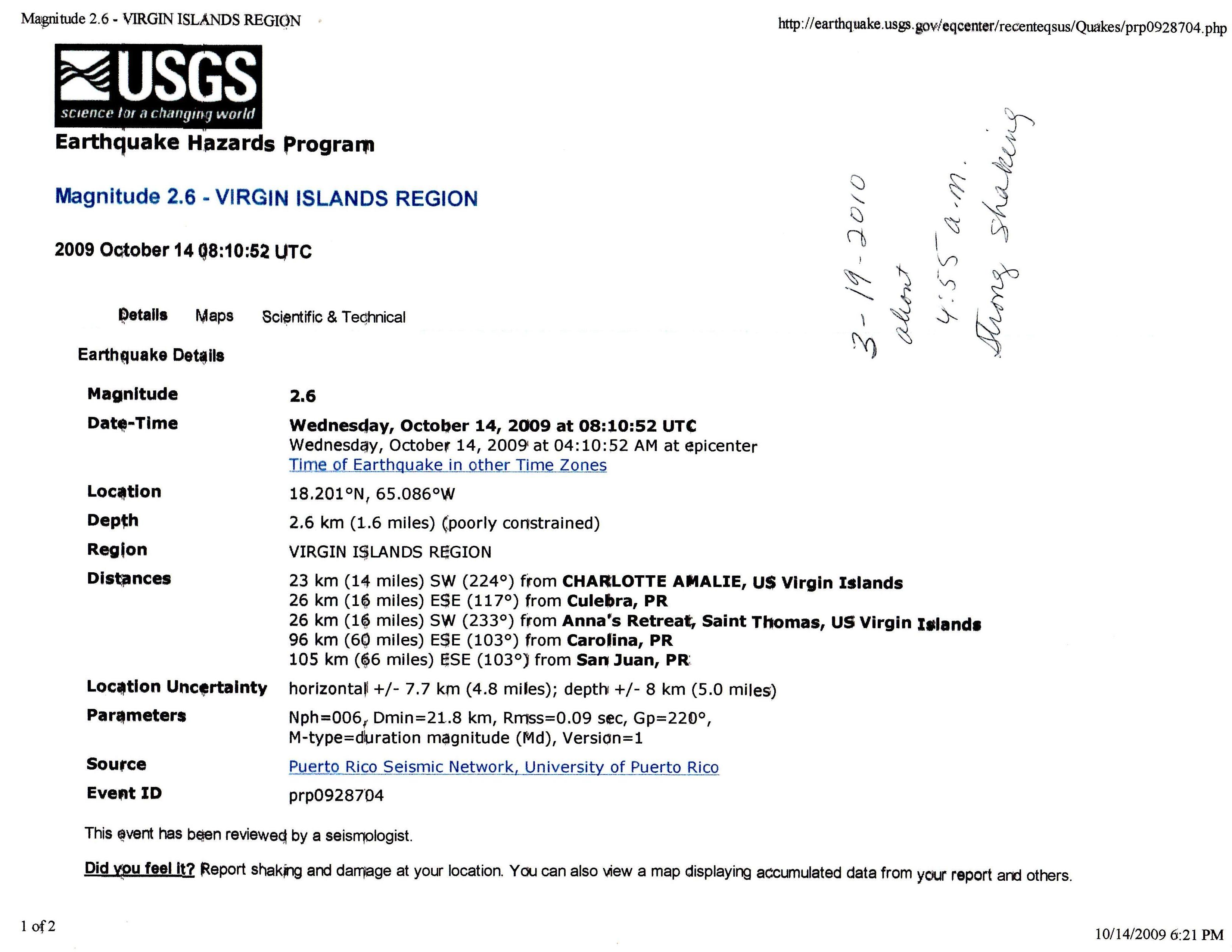
October 14, 2009 the ground shook violently in my sleep, and I awoke convinced that Jacksonville had experienced a serious shaking.  I made note of the time.  The next morning, as I talked this over with my kids, no one else felt the tremors.  I went online to the US Geological website, in search of earthquake documentation.  Sure enough, at the time of my awakening there was a 2.6 tremor 14 miles from the US Virgin Islands.

img007  During the months of November and December, 2009, the earth shook repeatedly and I awoke again and again, night after night; and with each incident, I tracked the time.  Daily I went to the USGS website, verifying my logged tremors.

From my 2009 journal, I found this interesting note:  Sunday March 8, 2009; I dream I am with a lot of young people in a big multi-story building.  A terrible disaster occurs and the building is partially destroyed.  Suddenly the manifest presence of God comes…His Glory in a great cloud of engulfing, blinding light.  We all fall down, prostrate before His presence.  I hear the hurting, wounded people all around me.  I get up and begin to help them, praying for them as I dig them out of the rubble.  I realize my oldest son is also in this building and I find him.  We help more buried, hurting people.  The blinding Glory of the Lord comes again and we all fall down in His presence, unable to move.  I awaken at 8:14 a.m.

I have another interesting dream journal log entry from May 25, 2011; however the dream came to my daughter and not me (she was 12 at that time and we were still in Jacksonville, FL).  She came into my office in the late morning and she was very upset.  I realized she had been sleeping and I told her to come sit on my lap.  I asked her what was wrong.  She began to tell me about a great earthquake that shook the central part of our nation such that the monuments on Mount Rushmore split in half.  She was terrified by this event.

In August of 2011, after we moved to Virginia, the entire North East Coast shook with the 5.9 Mineral, VA quake.  This time I was wide awake.  I was walking through my living room when I heard the dreaded sound of the groaning earth.  It started out as a rumbling, and as the walls and the house began to move, I heard the glass rattle and my kids calling out in fear.  We live less than an hour away from the epicenter.  The rest of that week, strong tremors and aftershocks continued.  The shaking underneath Mineral and Louisa, Virginia has continued, even as recently as December, 2013.  My nighttime earth shaking experiences continue as well.

DSCN9692

February 15, 2012, I dreamed I was sitting in my living room and suddenly a huge 8-9 ft man walks through the wall coming off the kitchen.  He was dressed in a full Scottish kilt, with the tam, the sash and a thick, white sweater underneath.  He gleamed, as if lit with his own light source.  He was crossing diagonally through the house, as if it wasn’t even there.  I yelped and cried out in great fear.  He stopped and looked at me, and then he called my name and began telling me the most shameful, secret things I had ever done.  His eyes burned with a fire I had never seen before.  I was crushed and terrified.  His thick Scottish accent made his words even sharper.

Suddenly I knew what to say to him.  “Yes, that was me,” I agreed, “before I let Jesus wash those sins away with His shed blood at the cross of Calvary.”

“You have answered correctly,” he replied, and he started to walk on through the wall.  I stopped him again and asked who he was and why he was walking through my house.  This time he stopped and he smiled.  “I am Towcheleth,” he replied, and then he disappeared through the hallway wall.

Greatly puzzled by this dream, I began trying to find the meaning of this name, which I only knew phonetically.  I searched name websites, name books and even general internet name searches.  One night several days after the dream, I was working on one of my website posts and I had a Strong’s Exhaustive Concordance opened to the Hebrew dictionary.  Suddenly it occurred to me that the name this man gave me might be Hebrew.  I had to search the entire reference section and it wasn’t until I got to the very end, 150 pages later, I discovered Hebrew # 8431: towcheleth (to-kheh-leth); expectation – HOPE; from Hebrew #3176: yachal (yaw-chal); a primitive root; to wait; by implication, to be patient; to cause to have hope, to have hope, to make to hope; to be pained, stay, tarry, trust, wait.[3] Finally I understood, Towcheleth was the Angel of Hope and he walked through my house on February 15, 2012.

Early morning, before 7:00 a.m, January 5, 2014; I dreamed of a massive earthquake that struck the nation and other parts of the world simultaneously.  I heard the earthquake minutes before the terrifying shaking began.  Others around me were crying out, trying to figure out what was making the pitiful, painful, ear-splitting groaning.  I knew it was the earth and I began to warn them to hold on and get ready.  Cities were leveled.  The devastation was unlike anything I had ever seen on the news or even in some movies.  My house was damaged slightly but deemed safe to occupy, and many homeless neighbors began to show up asking for shelter.  Friends and business associates came seeking me out, trying to make sense of all that was taking place on the earth.

I awoke from that dream, troubled and stirred up by the magnitude of what I had seen and experienced.  One specific scripture comes to mind as I remember this dream:  “We know that the whole creation has been groaning in the pains of childbirth right up to the present time.”[4]

I decided to look up the word here for ‘groaning’ – Greek #4959: sustenazo (soos-ten-ad-zo); to moan jointly; i.e. experience a common calamity – groan together; from G#4862: sun (soon); primary preposition denoting union, with or together; by association, companionship, process… and from G#4727: stenazo (sten-ad-zo); to make or be in dire straits; to sigh, murmur, pray inaudibly; – with grief, groan, grudge, sigh.[5]

I have one last dream I want to share; arguably it is the most important dream I’ve ever received.  September 17, 2011:  I am walking along a busy, broad sidewalk in New York City.  There are great crowds all around, and out of the corner of my left eye, I see a vividly bright, white robed figure walk past me.  Suddenly I realize it is Jesus.  I have never seen Him in person, and I am struck with awe and amazement that He is there beside me.  He catches my eye and He acknowledges me with a glance of His eyes.  He starts to walk away, but I call out His name and He stops.

I am weeping with the realization that I can see Jesus.  I ask Him not to pass me by without at least letting me hug Him.  He is happy with this request and opens His right arm to me in a loving embrace.  His face is not beautiful, like the paintings.  His face is marked with terrible scars.  His hands are scarred.  His feet are scarred.  I am broken by those marks on His face, His hands and His feet.  He holds me for several minutes and I feel the most amazing love I’ve ever experienced.  It pours out from Him.  He doesn’t speak, but His eyes tell me He has to go, there are others He must see and touch.  I reluctantly let Him go and He takes one step and just disappears into the person walking directly in front of me.  I wake up.  Immediately I think of this scripture:  “…to them God has chosen to make known among the Gentiles (non-Jewish believers) the glorious riches of this mystery, which is Christ in you, the hope of glory.”[6]   

Additional Notes:[7]

I will praise the Lord, who counsels me; even at night my heart instructs me.  I have set the Lord always before me.  Because He is at my right hand, I will not be shaken.  Psalm 16:7-8

Praise the Lord, all you servants of the Lord, who minister by night in the house of the Lord. Psalm 134:1

This is what the Lord says – your Redeemer, the Holy One of Israel:  “I AM the Lord your God who teaches you what is best for you, who directs you in the way you should go.” Isaiah 48:17

Seek the Lord, all you humble of the land, you who do what He commands.  Seek righteousness, seek humility; perhaps you will be sheltered on the day of the Lord’s anger.  Zephaniah 2:3

Rejoice greatly, O daughter of Zion, shout in triumph O daughter of Jerusalem!  Behold, your King is coming to you.  He is just and endowed with salvation…He will speak peace to the nations…and His dominion will be from sea to sea… As for you also, because of the Blood of My Covenant with you, I have set your prisoners free…return to your fortress, O prisoners of HOPE; even now I announce that I will restore twice as much to you.  Zechariah 9:9-12


[1] Psalm 139:17-18, “The Comparative Study Bible – New International Version”; copyright 1999; Zondervan, Grand Rapids, MI; page 1577.

[2] Matthew 2:13, 19-23; “The Comparative Study Bible – The New International Version”; ibid, pages 2427-2429.

[3] Hebrew 8431; towcheleth; 3176; yachal;  “The New Strong’s Exhaustive Concordance of the Bible”; Strong, James; copyright 1995, 1996; Thomas Nelson Publishers; Nashville, TN; pages 151 and 56.

[4] Romans 8:22; “The Comparative Study Bible – The New International Version”; ibid, page 2883.

[5] Greek 4959; sustenazo; 4862; sun; 4727; stenazo; “The New Strong’s Exhaustive Concordance of the Bible”; ibid, pages 88, 86, 83.

[6] Colossians 1:27; “The Comparative Study Bible – The New International Version”; ibid, page 3029.

[7] All notes; “The Comparative Study Bible – The New International Version”; ibid, pages 1381, 1569, 1837, 2375, 2403.

August 14, 2013

Shall God not search this out? For He knows the secrets of the heart.[1]

Keeping a secret can be one of the hardest self disciplines to master when you’re young and beginning to develop real friendships.  Secrets make or break every relationship we undertake.  Understanding the emotions behind the events that generate these surreptitious times will help reveal the power of the bond of secrecy.  Sometimes, though, God steps in and lays bare our most guarded issue.  Our own fear or even pride can keep us prisoner to problems.  Without the help of others, we would not be able to rise above the circumstances to which we are bound.

Years ago I was sitting in an evening choir practice.  I was part of a talented and dedicated group of people involved in the worship ministry at our church.  Every Thursday evening we gathered for practice.  I participated in this weekly gathering for 11 years before we moved out of state to our current home.  I always enjoyed getting away from family chores to be with my musical friends.  Our times together of learning and harmony were passionate, intense and sometimes very funny.  We were a choir family.

The day of this retelling was a cold day in February.  My many responsibilities made me late leaving home for practice.  When I arrived in the choir room I was not able to sit in my usual seat.  It is a common group dynamic when  people tend to be repetitive about such routine things as sitting in the same seat for regular scheduled activities.  In this situation, I was such a creature of habit.  I also dislike being late to any event.  That particular evening my normal peace of mind was slightly disturbed because of my tardiness.

I took a seat on the row behind my usual place, picked up the music and joined in the song.  Several minutes passed before our director stopped the song and began concentrating his attention on the tenor section to go over parts.  One of the foundational choir rules required the rest of us to be respectful and make as little noise as possible during a sectional rehearsal.  I sat there for a few minutes, just gathering my thoughts, and I looked over at my friend sitting on my left.  She seemed deep in thought.  Normally she was very personable and cheerful but this night she seemed lost in her own musings.

The sectional rehearsal dragged on and I began to look around again, just to take notice of all the friends present, when suddenly I had the following thought:  “She has no gas in her car.”

I sat still for a few more minutes, turning this information over and over in my mind.  A sense of urgency accompanied the thought and when the director turned his attention to another section for review, I began to be uneasy.  Feeling insecure about such a message, I finally nudged my friend and  cautiously whispered, “You have no gas in your car, do you?’

For a good 20 or 30 seconds, my friend looked at me like I had slapped her in the face.  I was upset with myself for saying such a crazy thing to her, when her eyes filled with tears, and she shook her head “no”.

My personal finances were not spectacular at that moment either but I knew that I had to get her a tank of gas.  “When we leave practice,” I whispered, “we’ll go straight to a gas station and take care of it.”

My friend hurriedly wiped away a tear and smiled in gratitude.  I knew she was in the middle of a marriage breakdown.  I slid my arm around her shoulders and gave her a quick hug.  When I hugged her, this thought came:  “She has no food at home either.”

Sobered by this daunting notion, I knew I could not whisper such a thing, so I took out a piece of paper and quickly scribbled a note:  “You have no food at home either, do you?’

This time, her expression changed from the timid smile she had just given me to a broken, puzzled look.  Once again tears formed and she shook her head “no”.

My own relationship with my spouse was under great duress.  Our finances were severely challenged.  My husband was working out of town on his new job and our family was still in Jacksonville awaiting the sale of our home so we could move and join him.  He was the official family book keeper.  This night, I knew that I was probably going to get a lecture for my actions but I could not let my friend’s needs go unanswered.

“We’re going to the grocery store after practice,” I scribbled back to her.  Then I dug in my purse and found a tissue.  She wiped her tears and gave me a quick hug back.

As practice wrapped up, I had another revelation:  “She is not going to tell you what she really needs.”  Then, a list of items began to flow through my mind.  I knew she needed pet food and many other personal things.  We walked out of practice and made a plan to meet at the nearest store and gas station.  As I drove the few miles to the shopping center, her list kept getting longer and her needs more detailed and specific.

We  both got shopping carts when we arrived at the grocery store.  I had my own grocery needs too.  As we started down the first aisle, my friend said, “I only need bread, eggs and milk.”

At this moment, the power of the impressions I was receiving was beginning to give me a great sense of awe and wonder.  I knew Holy Spirit was looking at her needs and speaking directly to me about satisfying them.  I chuckled and stopped my friend, taking her hand into mine and getting her full attention:  “You need these things,” I said, as I began to describe all the items that had gone through my mind.  “Are you going to tell me what you really need or are you going to make me do this entirely by the Spirit?” I was joyful by this time and totally in awe of the moment.  My list was so specific she finally blushed and shook her head in amazement too.

“This is unbelievable,” she declared as we walked up and down the aisles, and I put things in her cart.  We stopped at the pet food aisle and I asked her what kind of food her pets liked.  She started to pick up the cheapest food available.  I knew her cat and dog would not eat her choices.  “They’re not going to like that kind,” I told her.  Finally she started to laugh, catching the joy of the Lord that was being offered to us both.

We turned down the seasonal items aisle and I stopped in front of some boxed valentines for kids.  “Your daughter needs these for school tomorrow doesn’t she?” I asked.

My friend finally looked at me again and shook her head.  “What is your husband going to say?” she asked.  She knew how picky he was over finances.

At that moment, a strange message came out of my mouth; one which has burned in my heart over these past years since we left Jacksonville:  “I’m sowing for my future,” I replied.

We finished our shopping and then we went to the gas station.  My friend hugged me repeatedly.  We both marveled over the gift of supernatural knowledge Holy Spirit released in this moment  – knowledge which deeply impacted both of our lives.

Many people don’t really understand the concept of spiritual gifts, like I operated in the evening I received such a critical message.  First of all, the most important gift God ever gave was Jesus.[2]  Jesus explained, “When the Helper (Holy Spirit) comes, whom I will send to you, from the Father (that is the Spirit of Truth – who proceeds from the Father), He will testify about Me.[3]

The apostle Paul explained that as we become ‘in Christ’ (part of Christ’s spiritual body, His kingdom of believers) we become partakers of heavenly gifts that reveal the presence and power of Jesus in our everyday life.  Jesus has acquired the right to give these gifts based upon His supernatural conception, His sinless life, His death and His resurrection.

But to each one of us grace was given according to the measure of Christ’s gift.  Therefore it says, When He ascended on high, He led captive a host of captives, and HE gave gifts to men.”[4]

Paul uses the word doma [Strong’s Greek #1390 – gift, present; from the base of 1325; to give, to greatly modify by the connection, adventure, bring forth, grant, have power, etc.][5]  My gift of knowledge certainly did generate quite an adventure that night.

Paul says that these gifts are irrevocably given to us.[6]  Once we are endowed with these gifts, God does not take them back.  If we ignore, neglect or misuse them, we will be accountable.[7]

Talents, in the parables Jesus shared through out His ministry time, always represent elevated abilities or something given which enabled the receivers to invest or accomplish work, with an expected return.  The gospel writer, Matthew, is the only one to use this Greek word talanton and it means a balance of certain weight, or a specific sum of money.[8]

Gifts, on the other hand, represent (but are not limited to) the supernatural abilities that Jesus modeled during His physical time on earth.  He declared that we would do greater works than He preformed.[9]

Paul used the word charisma when describing the irrevocable gifts in the book of Romans.  [Strong’s Greek #5486 charisma (khar-is-mah); means “a divine gratituity, deliverance from danger or harmful passions, spiritual endowment, religious qualification, miraculous faculty – free gift.”][10]  The 12th Chapter of Romans provides the following list:

  • Prophecy (prophetic insight, the gift of interpreting the divine will and purpose)[11]
  • Practical service through ministry
  • Teaching
  • Exhortation (encouraging words that build our faith)
  • Contributing to the needs of others, giving generously
  • Leadership for governing diligently
  • Showing mercy cheerfully

Paul starts out with pneumatikos when introducing the gifts in his first letter to the Corinthians.  [Strong’s Greek #4152 pneumatikos (pnyoo-mat-ik-os); means non-carnal (not human), ethereal, (divinely) supernatural…][12]   He goes back to charisma several sentences later as he develops this most interesting topic and he explains, “But to each one is given the manifestation of the Spirit for the common good.”[13]  I believe my friend would agree that our shopping experience that night in February was for common good.

The 12th Chapter of First Corinthians gives this insight: “Now there are varieties of gifts (charisma)…but the same God who works all things in all persons.”  The spiritual gifts listed here include:[14]

  • Word of wisdom
  • Word of knowledge
  • Faith
  • Gifts of healing
  • Workings of miracles
  • Prophecy
  • Discernment or distinguishing of spirits (evil and good)
  • Various kinds of tongues (speaking an unlearned or unknown language)
  • Interpretation of these tongues (languages)
  • The office or role of apostleship
  • The office or role of a prophet
  • The office or role of a teacher
  • Helps (serving the physical needs of people)
  • Administration

It is interesting how Paul then goes on to give the analogy of the human body and how it has many different members but each member really belongs to all of the body and how uniquely the body needs each member.  “If one member suffers, all the members suffer with it, if one member is honored, all the members rejoice with it.”[15]

That February night, my friend was suffering and she needed more than a congenial pat on the back – she needed real help. “What good is it, my brothers, if a man claims to have faith but has no deeds?  Can such faith save him?  Suppose a brother or sister is without clothes and daily food.  If any one of you says to him, “Go, I wish you well, keep warm and well fed,” but does nothing about his physical needs, what good is it?  In the same way, faith by itself, if it is not accompanied by action, is dead!”[16]

Paul then gives this advice:  “Eagerly pursue and seek to acquire (this) love (make it your aim, your great quest); and earnestly desire and cultivate the spiritual endowments (gifts), especially that you may prophecy (interpret the divine will and purpose in inspired preaching and teaching).[17]

On that cold February night, God used His words of knowledge, enabling me to help my friend.  What I didn’t know, as I handed her the valentines, is that I would walk a very similar path in September of 2012.  My marriage broke down; my husband left to go do his own thing.  Numerous times my children and I experienced these same needs.  I have been out of the job market for 20 years, primarily being a wife, mother, writer and laboring as a volunteer.  Going right back into the work force has been no simple task.  I had to open up and share my secret hurt and needs with others to get through this tough time; and indeed, on that February night, I was “sowing for my future”.

I feel confident that everyone who has comforted me in my brokenness will one day reap the same supernatural favor I’ve experienced.  “For the word of God is living and active; sharper than any double edged sword.  It penetrates even to dividing soul and spirit; joints and marrow; it judges the thoughts and the attitudes of the heart.  Nothing in all creation is hidden from God’s sight.  Everything is uncovered and laid bare before the eyes of Him to whom we must give account.[18]

Texts and Books I’ve read on this subject:

Growing in the Prophetic, by Mike Bickle

Surprised by the Power of the Spirit, by Jack Deere

The Beginner’s Guide to Spiritual Gifts, by Sam Storms

The Finger of God, by Mark Rutland

When the Spirit Comes with Power, by John White

Your Spiritual Gifts, by C. Peter Wagner

You May All Prophesy, by Steve Thompson

Romans Chapter 12

I Corinthians Chapters 7, 12-14

Ephesians Chapters 3 & 4

I Peter Chapter 4


[1] Psalm 44:21, “The Comparative Study Bible – The New American Standard Version,” copyright 1999; Zondervan Publishers, Grand Rapids, Michigan; page 1430.

[2] Matthew 7:11, Luke 11:13, John 4;10, Romans 5:15-21, Romans 6:23, Romans 11:29, Ephesians 2:8-22,

[3] John 15:26, Luke 11:11-13; “The Comparative Study Bible – The New American Standard Version,” copyright 1999; Zondervan Publishers, Grand Rapids, Michigan; pages 2747 and 2633.

[4] Ephesians 4:1-13; ibid, pages 3005-3007.

[5] Doma, Strong’s Greek Number 1390; The New Strong’s Exhaustive Concordance of the Bible”;  copyright 1995, 1996, Thomas Nelson Publishers, Nashville, Tennessee; page 24.

[6] Romans 11:29; ibid, page 2893.

[7] I Timothy 4:14, II Timothy 1:6; ibid pages

[8] Talanton; “Strong’s Greek Number 5007; The New Strong’s Exhaustive Concordance of the Bible”;  copyright 1995, 1996, Thomas Nelson Publishers, Nashville, Tennessee; page 89.

[9] John 14:11-14; ibid, page 2743.

[10] Charisma; “Strong’s Greek Number 5486; The New Strong’s Exhaustive Concordance of the Bible”;  copyright 1995, 1996, Thomas Nelson Publishers, Nashville, Tennessee; page 98.

[11] I Corinthians 12:10; “The Comparative Study Bible – The Amplified Version,” copyright 1999; Zondervan Publishers, Grand Rapids, Michigan; page 2934.

[12] Pneumatikos; “Strong’s Greek Number 4152; The New Strong’s Exhaustive Concordance of the Bible”; ibid; page 72.

[13] I Corinthians 12:4; “The Comparative Study Bible – The New American Standard Version,” copyright 1999; Zondervan Publishers, Grand Rapids, Michigan; page 2935.

[14] I Corinthians 12:1-31; ibid.

[15] I Corinthians 12:26; ibid.

[16] James 2:14-17; ibid, pages 3123-3125.

[17] I Corinthians 14:1; ibid, page 2939.

[18] Hebrews 4:12-13; ibid, page 3093.